They discuss the history of Korea, Japanese colonial occupation of Korea, WW2 and the Cold War, The Korean War, Kim Il-Sung and guerrilla warfare, South Korea as an American puppet state, the Soviet Union and Mao’s China, American propaganda against the DPRK, the prospects for a unified Korea, and much more!
How an American Korea and a Korean Korea came to blows over the same territory on this day 71 years ago
June 25, 2021
By Stephen Gowans
Korea, as a nation, has existed within the same space for over a thousand years, but it is only since 1948 that it has been divided into two states, and the division is the consequence of a US decision taken in pursuit of US geopolitical aims, without the slightest regard for the wishes or aspirations of Koreans, who didn’t want their country divided politically.
Had the United States not intervened in Korea at the end of the Second World War, historians agree that the nation would have emerged from the war, and from its years of colonization by the Japanese, with a politics that favored communism, or at the very least, favored a very robust leftist agenda, because that’s what Koreans, in the majority, wanted.
Koreans were, in the main, peasants, who were exploited by a tiny landlord class. And they lived in a country that was oppressed by the Japanese. They would naturally be inclined toward communist politics, since communist politics aimed at overcoming exploitation at all levels, including the levels of class and nation.
Today there are two states on the Korean peninsula, the Republic of Korea, or South Korea, the creation of the United States, and the Democratic People’s Republic of Korea, or North Korea, the creation of Koreans, and the successor to the People’s Republic of Korea, the state Koreans proclaimed for themselves at the end of WWII, before the United States arrived on the peninsula, and refused to recognize it.
These two states—one an American Korea, the other a Korean Korea—each claim to be the sole legitimate state in the country.
Kim Il Sung, who was the first leader of North Korea, worried that the division of Korea into US and Soviet occupation zones, which was done at the end of the Second World War to accept the Japanese surrender, would inevitably lead to the division of Korea into two states—one of patriots, and one of traitors.
The patriots, in Kim’s view, would be the Koreans who fought the Japanese colonization of Korea, and aspired to an independent Korea. The traitors would be the Koreans who collaborated with the Japanese, who, Kim believed (correctly it turns out), would also collaborate with the Americans. Kim recognized that the United States was an imperialist power that would seek to dominate Korea, as Japan had done, and would recruit collaborators to assist it, also as Japan had done.
Coveted by Great Powers
Koreans have had the great misfortune of inhabiting territory that has been either coveted by powerful states or dominated by them. China (which Korea borders), Russia (which Korea borders), Japan (which lies nearby across the Sea of Japan), and the United States (which regards itself as an Asia-Pacific power) have all, at one time or another, sought to make Korea, if not their own, then at least subservient.
Korea was long a tributary of its neighbor China.
After Japan modernized, and fell under a compulsion of its capitalist economy to seek markets for its industrial products, sources of raw materials, investment opportunities, and territory to settle its surplus population, its rapacious gaze fell upon Korea. The Sino-Japanese war was fought over the question of who would control the country: China or Japan. The Japanese won the war and therefore won Korea.
Russia was also interested in Korea. Japan and Russia fought the Russo-Japanese War over control of Korea (and Manchuria), a war the Russians lost, to the great consternation of the West, for this was the first time a Western power had been defeated by an Eastern one.
Finally, the United States fought Japan over control of all of East Asia, and when it defeated Japan in 1945 with the help of Britain and the Soviet Union, its intention was to supersede Japan as the hegemonic power in the region. Its goal was to make all of East Asia an American neo-colony.
Japanese Colony
Japan formally colonized Korea in 1910 and remained the colonial power for the next thirty-five years.
These were very harsh years for Koreans.
Korean culture was outlawed. All Korean political organizations were disbanded. Korean newspapers and public gatherings were prohibited. The education system was Japanized. Koreans were forced to speak Japanese, take Japanese names, and worship at Shinto shrines, even though Shintoism, the traditional religion of Japan, was foreign to Korea.
Koreans were coerced into service as conscripted laborers, sent to every corner of the empire to satisfy the requirements of Japan’s military and economic expansion. At the close of World War II, one third of industrial workers in Japan were Koreans.
At the same time, Korea was transformed into a Japanese granary. Agriculture was steered away from Korean needs to Japanese needs. The Japanese ate more Korean rice per capita than the Koreans did.
Korea, thus, became a means to Japanese ends, a country that existed to serve Japan, not itself.
Inspired by the Soviet Union and Communism
Koreans found themselves in a dual debased condition. Most were peasants, exploited by landlords. And they lived in a country oppressed by a foreign power. Such a people couldn’t help but be inspired by a Soviet Union that called for an end to the exploitation of man by man, and an end to the division of the world into oppressor and oppressed nations.
Moreover, the Soviet Union was not only calling for an end to these debased conditions, it was showing how they could be overcome. For example, the Bolsheviks had given land to the peasants and ended the rule of the landlords, something that would certainly appeal to Korean peasants who toiled under the oppression of Korean landlords. They also successfully repelled a dozen capitalist powers that tried to bring Russia under their control in the wake of the Bolshevik Revolution.
Later, the USSR emerged victorious from the greatest colonial war ever waged, that of Nazi Germany against the Soviet Union, impelled by the German imperialist aim of enslaving the peoples of Eastern Europe. Germany said its war for lebensraum would create its own American West or its own East Indies in Eastern Europe. The Soviet victory in repelling the attempted colonization of Eastern Europe was an inspiration to colonized people everywhere, Koreans included.
What’s more, communists were at the forefront of the struggle against Japanese colonialism. Kim Il Sung and Mao Tse Tung were major figures in the resistance.
Finally, the Soviet economy offered oppressed people a model of how to modernize and industrialize.
Washington’s Interest in Korea
The United States had the same interests in East Asia as Japan had—to exploit the region as a market, source of raw materials, and sphere for investment.
Koreans hated the United States because they saw the country quite correctly as another imperialist power, no different from Japan. Washington had blessed Japan’s colonization of Korea in return for Tokyo blessing the United States’ colonization of the Philippines.
Thus, in the view of Koreans, these two countries were robbers, seeking to divide up East Asia between themselves.
Kim Il Sung made fun of Syngman Rhee, the anti-communist Washington picked as the first president of South Korea, because Rhee had spent over four decades in the United States lobbying Washington to free Korea from Japanese rule. Kim said this was like asking a robber who waits outside your house to help you evict the robber already inside your house.
Koreans, with the exception of people like Rhee, had no illusions about what the United States was, namely, a predator, waiting outside their door to rob them once the Japanese were evicted.
The US-Orchestrated Political Division of Korea
The United States created the Republic of Korea in 1948, over the objection of most Koreans, who saw the American project of establishing a state in the US occupation zone as an attempt to create a permanent political division of their country. Few Koreans wanted this. What they wanted was a unified, independent, communist Korea.
But the only way Washington could prevent Korea from becoming a communist state, or at the very least, a country with a robust leftist agenda and preference for political independence, was to artificially implant an anti-communist Gestapo-like police state in the US occupation zone to crush the political aspirations of Koreans who favored a unified communist country.
As mentioned, to accept the Japanese surrender, the peninsula had been divided at the end of WWII into two occupation zones, an American one, and a Soviet one. By agreement, the occupations and division were to last no longer than five years. Before the end of this period, elections were to be held for a pan-Korean government and the occupying armies were to leave. (The Soviets departed at the end of 1948. The Americans stayed and have never left.)
It was clear to Washington, that the election would be won by anti-imperialist, pro-communist forces, who would oppose a continued US presence on the Korean peninsula. Washington, then, had a choice. Lose all of the peninsula or keep the half it controlled. It chose to keep the half it controlled. To retain its influence in Korea, the United States created a puppet state in its own occupation zone. And then it boldly claimed that the state it created was the sole legitimate state in Korea, representing all Koreans.
The only possible response to this attempt to preempt the creation of an independent, unified Korea, was for Koreans who held out the hope of a Korean Korea to create their own state, as the sole legitimate state in the country.
That was why the DPRK was founded. It was also how the division of Korea between an American Korea and a Korean Korea came about.
The Patriot
Bruce Cumings, the leading US historian of Korea, recounted in his book, Korea’s Place in the Sun: A Modern History, that when “the leading scholar of Korean communism, Dae-sook Suh, was finally allowed to explain the real story to a large audience of young people in Seoul in 1989, upon hearing that Kim Il-sung was in fact a hero of the resistance, they all burst into applause.”
That, in short, is who Kim Il Sung was – a hero of the anti-Japanese resistance. Kim was so important as a guerilla leader that the Japanese established a special Kim unit to hunt him down, and they staffed it with Korean traitors who would later be recruited by the Americans to play leading roles in the South Korean military.
Kim spent 13 years in top positions in the armed struggle against the Japanese, and on the eve of his return to Korea after the Japanese surrender, the major Korean leaders of the resistance agreed that, owing to Kim’s reputation, his charisma, and his abilities, that he should become the principal political leader of a Korean Korea.
He wasn’t selected by the Soviets, but was chosen by his peers in the resistance. Indeed, the Soviets never fully trusted Kim, but within their occupation zone, they allowed Koreans to administer their own affairs independently, and to promote Kim as the leader of a Korean Korea.
The Korean War
There are many views of what the Korean War was, or is.
One view is that the Korean War began in the early 1930s when Kim Il Sung created his first guerilla unit, and began to fight Korean traitors who collaborated with the Japanese, traitors who would then form the core of the US-created Republic of Korea, while Kim and his colleagues formed the core of the DPRK. According to this view, the Korean War is a war between the traitors of the American Korea and their descendants and the patriots of the Korean Korea and their descendants, and that, so long as these two states independently exist, the war between patriots and traitors, between those who oppose imperialism and those who collaborate with it, between American Korea and Korean Korea, never ends.
Another view is that the Korean War began in 1945, when the United States arrived on the peninsula and went to war with the People’s Republic of Korea, and five years later, with its successor, the Democratic People’s Republic of Korea.
A third view is that the war began in 1948, when the United States created a permanent political division in the nation by setting up an American Korea in the form of an anti-communist, Gestapo-like police state, staffed at the highest level of its military with pro-Japanese traitors, over the objections of the majority of Koreans. This presented Koreans with no choice, if they were to have a Korea that met their preferences, but to go to war to liberate their country.
This view, as the preceding one, sees the Korean War as a war of the United States on Koreans, whereas the first view sees the Korean War as a civil war, between those who fought against imperialism and those who collaborated with it.
The conventional view of the war is that it began on June 25, 1950 when North Korean forces crossed the 38th parallel, and immediately drove the South Korean army deep into the south. The United States soon after intervened, driving the North Korean forces out of the south, and deep into the north, up to the Yalu River, which divides Korea and China. At that point, China intervened, and China and North Korea drove US forces back across the 38th parallel where the war bogged down for the next two years. The war ended in an armistice in 1953 and a peace treaty has never been signed.
What most Americans don’t know about the war is that there was no moral or legal basis for US intervention.
There was no moral basis because American Korea was unacceptable to most Koreans. Because the collaborator government had little popular support, its army immediately collapsed. North Korea would have quickly won the war, millions of lives would have been saved, Koreans would have achieved the communism they desired, and an independent, unified, Korea would have been born, had the United States not intervened.
Fundamentally, the war was a civil war between Korean Koreans and American Koreans, a quarrel over how to organize the social, political and economic life of the nation. At the heart of the quarrel was the question of equality. Are nations equal, or are some nations destined to lead others, and to have rights and privileges senior to others? Should exploitation be prohibited or welcomed? Should the country be integrated into the US Empire, or independent? And who should form the governing elite—collaborators with the Japanese Empire, or those who waged war against it? These questions were at the heart of the conflict.
Also, there was no legal basis for the US intervention, because there was no aggression across an international border. When North Korean troops crossed the 38th parallel on June 25, 1950 they crossed an imaginary line drawn in 1945 by two US colonels to separate US and Soviet occupation armies. This was not an international border separating two countries. It was simply a dividing line that came to separate two Korean armies. Koreans cannot invade Korea. What’s more, North Korea’s military action against territory occupied by a foreign power and its Korean collaborators was not an invasion; it was an attempt at liberation.
The War’s Aftermath
Open hostilities came to an end because the United States threatened a nuclear strike unless the North Koreans and their Chinese allies came to terms with Washington. Because the United States wielded a nuclear sword, it was able to drive a hard bargain, and the North Koreans and Chinese had little choice but to accept many US demands.
The United States left behind tens of thousands of troops and brought tactical nuclear weapons onto the peninsula which weren’t withdrawn until 1991. North Korea believes those weapons remain. At about the same time, the United States retargeted some of its strategic nuclear missiles away from the Soviet Union, which had dissolved at this point, to North Korea. Thus, for decades, the United States has cast a nuclear shadow over the Korean peninsula.
That’s a key point in any talks about denuclearizing the peninsula. To North Korea, denuclearization means that the nuclear shadow Washington casts over Korea must be lifted. To Washington, denuclearization means North Korea must abandon its nuclear weapons but that the US nuclear shadow can remain.
Thesis and Antithesis
From 1961 until 1979, South Korea was ruled by Park Chung-hee, a military dictator who had served in the Imperial Japanese Army, and who had hunted down Korean guerillas liked Kim Il Sung. During this period, Park served as the largely figurehead ruler of an American Korea and Kim Il-Sung ruled in Korean Korea—the traitor versus the patriot.
From 2013 to 2017 Park’s daughter was president of South Korea and Kim Jong Un, Kim Il Sung’s grandson, was leader of North Korea. As Bruce Cumings has pointed out, the conflict between traitors and patriots carried on in their descendants.
Park nurtured a capital-centered economy, in which South Koreans “had the right to work the longest hours in the industrial world at wages barely able to sustain one’s family,” as Cumings wrote. Kim preferred a people-centered economy, and had introduced an eight-hour work day and social security within months of coming to power.
Park was greatly hemmed in by the influence exercised behind the scenes by the US military commander, US ambassador, and CIA station chief—the decision-makers with ultimate authority in American Korea. Tens of thousands of US troops occupied the domain over which the southern leader’s state ruled. And his military reported, not to him, but to a US general. In the north, there were no foreign troops, and Kim preached a doctrine of self-reliance, which eschewed dependency on foreign powers.
In the south, the top political leader was a traitor to the Korean project of national liberation; in the north, the top political leader was a patriot who had devoted his life to Korea’s liberation.
In the south, the state was part of an empire. In the north, the state rejected empire.
The state of the south was founded by a foreign hegemon. The state of the north was founded by guerrilla leaders who had fought against foreign hegemony.
US Propaganda
US propaganda paints a false picture, not only of the DPRK, but also of the Republic of Korea.
It doesn’t tell you that South Korea is not an organically created Korean state, but a state created by Washington to serve US aims: an American Korea.
It doesn’t tell you that for decades, until the 1990s, South Korea was ruled by a series of vicious anti-communist military dictators, who ran a Gestapo-like police state that locked up communists and leftists, for infractions as mild as having something good to say about the DPRK or reading Marx and Engels.
It doesn’t tell you that there was a massive guerilla war in the south from 1945 to 1950 against the United States and its South Korean puppet, and that American Korea built concentration camps to hold the tens of thousands of Koreans who opposed the US presence in their country.
It doesn’t tell you that the military of American Korea has always been under the command of US generals.
It doesn’t tell you that 300,000 troops of American Korea fought on the American side in Vietnam in return for injections of economic aid from the United States, making the American Korea a mercenary state, on top of a traitor state.
It doesn’t tell you that the South Korean military has been trained and equipped by the United States to kill communists. It killed communists in the south from 1945 to 1950, communists in the north from 1950 to 1953, and communists in Vietnam during the 1960s and 1970s. It is being trained by Americans today to kill the communists of a country Washington deems its enemy: China.
And it certainly doesn’t tell you that while Washington has done all it can to ensure that American Korea succeeds economically, it has also done all it can to immiserate Korean Korea.
The Future
North Korea’s manufacture of nuclear arms and ballistic missiles capable of striking US targets effectively forecloses the possibility of a US invasion of North Korea and a US nuclear strike. By using nuclear weapons to substantially enhance its means of self-defense, the DPRK is able to re-allocate resources from its military to its civilian economy, to mitigate the effects of the world’s longest and most comprehensive sanctions regime. No country has been the target of as long and comprehensive a campaign of economic warfare as the DPRK.
Concerning the prospects for a unified Korea, the key question is: Will it be a Korean Korea or an American Korea?
Washington’s favored unification scenario is one in which North Korea follows the East German path of annexation by its neighbor and absorption into the US empire. Since the early 1990s, US officials have expected this scenario to play out. Three decades later, their expectation has proved to be wide of the mark.
A Korean Korea, on the other hand, cannot be born unless the American Koreans evict US troops from the peninsula. Since the collaborators of the South Korean government evince no strong predilection for parting company with their American master—and since the possibility of North Korea unifying the peninsula by force is beyond the DPRK’s capabilities—the possibility of a unified Korean Korea is remote. But it’s the nature of anti-colonial struggles that they’re often long-term projects.
Kim Il Sung recognized that Korea’s fight for freedom might last hundreds of years. He wrote, “India won its independence from England after 200 years of colonial enslavement. The Philippines and Indonesia won their independence after 300 years. Algeria after 130 years. Sri Lanka after 150 years and Vietnam after nearly 100 years.”
It may take 200 years, maybe longer, for Korea to win its struggle, but one day all of Korea will be Korean.
On the eve of the First World War, and for a good many years thereafter, the bulk of humanity was in the thrall of a handful of great powers: Britain, France, Russia, and the rising powers of the United States, Japan, and Germany. These self-declared chosen nations and soi-disant models for humanity, enjoyed unexampled prosperity as the product of their ruthless despoliation of nine-tenths of humanity, made possible by their military and industrial supremacy.
In East Asia, the French raped Indochina; the British plundered Borneo, Malaya, Siam, and Hong Kong; Japan held Taiwan, Korea, and Manchuria in colonial subjection; the United States colonized the Philippines and Guam; the Netherlands looted Indonesia; the Portuguese enslaved Macau and East Timor; and China, as Sun Yat-sen remarked, was exploited by everyone.
The First World War—the Weltkrieg, or World War, as the Germans called it—marked the beginning of the end of the Columbian period, that era marked by the plunder of the world by Europe and its offshoots beginning with the voyages of Columbus to the Americas at the end of the fifteenth century and continuing through today. The 500-year-plus domination of Asia, Africa, and Latin America by the West has been aptly called “The 500 Year Reich,” an allusion to the identity of the practices used by the Nazis with those of their predecessors and contemporaries, not only by Germany, but also by the other ‘model nations’ as well. These practices comprised the methodology of colonialism. Deployed by Spain, Portugal, Britain, France, the United States, Italy, and Japan outside Europe, they became the paradigm for the Nazis, whose great crime in the eyes of their rivals was that, as Sven Lindqvist put it, they did in the heart of Europe what had theretofore only been done in the hearts of Africa, Asia, and the Americas. Racism, genocide, dispossession, and colonial subjugation outside of the metropole were acceptable in the capitals of Western Europe and North America, deemed necessary and inevitable, even extolled, but became great iniquities only when the Nazis inflicted them upon Europe.
Today, nearly half of the world’s wealth is controlled by the 10 percent the population that makes up the G7 countries, while the other half is shared by the remaining nine-tenths. The chasm dividing the East from the West has considerably narrowed with the Communist Party-orchestrated rise of China, a phenomenon ultimately traceable to what Domenico Losurdo argued was the signal event of the Weltkrieg.
The World War of 1914-1918 was many things, but among these it was “a war between two groups of the imperialist bourgeoisie for the division of the world, for the division of the booty, and for the plunder and strangulation of small and weak nations,” as Lenin put it. Lenin called for unity among the workers of the “model” nations, to emancipate, not only their labor from its exploitation by the bourgeoisie, but also to liberate their bodies from the war of industrial extermination the bourgeoisie had visited upon them. At the same time, the Bolshevik leader called for unity between the workers of the West and the oppressed peoples of India, China, Korea, Indochina, and elsewhere, against their common oppressor, the metropolitan bourgeoisie. Broadening the compass of Marxism, the Bolsheviks extended Marx’s and Engel’s 1848 battle cry “Workers of the world unite!” to “Workers of the world and oppressed peoples, unite!”
This widening orientation, along with the Bolsheviks’ success in using the state and patriotism to mobilize the Russian population against the intervention of the “model nations” in Russia’s Civil War of 1919–21, inspired revolutionary nationalists like Mao Zedong, Ho Chi Minh, and Kim Il Sung, inaugurating a movement to end the 500-year Reich.
The World War, and the Bolshevik Revolution that sprang from its womb, had generally positive effects in the East. The toll of the war weakened the grip of the exploiting nations upon the peoples they exploited, while the Bolshevik example precipitated the anti-colonial revolution in the East. An Eastern Marxism developed, responsive to the needs of colonial peoples to overcome their dependency and achieve political and economic sovereignty. Revolutionary nationalists would make good use of patriotism, the state, and industry to achieve political sovereignty and economic independence, as well as to protect dearly bought gains from the unceasing efforts of the imperialist Leviathans to reverse them.
By contrast, the Weltkrieg was a catastrophe in the West, and Western Marxism developed to reflect the experience of the war in Europe. Whereas the revolutionary nationalists of the East harnessed patriotism to the project of national liberation, Marxists in the West eschewed national devotion as a bourgeois subterfuge used to divide the proletariat along national lines. In the East, Marxists saw violence as a means of liberation and the military as an instrument for defending national revolutionary gains. In the West, the horrors of the war envenomed Marxists to violence and the military. Marxists of the Orient viewed the state as the means to organize economic development and as an instrument of repression to be ruthlessly deployed in the defense of revolutionary nationalist gains. Marxists of the Occident viewed the state with suspicion, an engine of class oppression, that had been used against them.
Each form of Marxism represented a set of proposed solutions to the problems of emancipation present at a specific time and place. In the East, the germane question concerned how people under colonial and semi-colonial domination could achieve political and economic sovereignty and safeguard their achievements once gained. In the West, the relevant question revolved around how to win political power to liberate industry from the control of shareholders and financiers and vest it in the hands of the proletariat.
Whether intentional or not, A.B. Abrams’ Immovable Object: North Korea’s 70 Years at War with American Power, examines the relationship between North Korea and the West from an Eastern Marxist perspective. Without using the idiom, Abrams presents the DPRK as a quintessential Eastern Marxist state. Korean patriotism, strong central authority, military preparedness, self-reliance, and the development of nuclear weapons and ballistic missiles are identified as sources of North Korea’s resilience in the face of Washington’s 73-year project to bring about “the end of North Korea”, as John Bolton once described Washington’s policy aim. These practices are presented as the bases for the DPRK’s success in achieving the revolutionary nationalist goals that lie at the center of the Eastern Marxist project.
Abrams’ history of the DPRK-US relationship begins with the arrival of US forces in Korea in 1945, after Koreans had declared a Korean People’s Republic, with which the US military government immediately went to war. Abrams devotes considerable attention to the Korean War, known as the Great Fatherland Liberation War in North Korea (memorializing the success of the combined Korean and Chinese forces in evicting the US invaders from territory administered by the DPRK), and the War to Resist America and Aid Korea, in China. Nearly half of the tome, weighing in at 675 pages, covers events since 1990, and a substantial part deals with recent events.
Abrams’ history is not archival; he uncovers no new facts. Instead, it is perspectival, offering a fresh take on what the archives have already revealed—or, what seems like a fresh take to those, like myself, who are familiar with an historiography that is congenial to the Western Marxist perspective. To illustrate, Abrams makes an observation and poses a question that, at best, are quickly passed over in Western accounts, if broached at all, but within the framework of Eastern Marxism, are critical. The observation is this: Of small countries that have liberated themselves from the iron-grip of colonialism, only North Korea, a country of a mere 24 million, has survived the aggressions of US imperialism, stood unbowed before relentless military pressure, withstood the burdens of sanctions, and developed its military strength to a high degree sufficient to take a US war on the East Asian state off the table. To be sure, in the realm of post-colonial resistance to US imperialism, Cuban resilience also stands out, but unlike the DPRK, Havana cannot stay the hand of US military aggression with a retaliatory strike capability.
Indeed, there is a lengthy list of states that have succumbed to US efforts to reverse the tide of national liberation. Egypt betrayed the Arab nationalist cause; the Soviet Union surrendered; Ba’athist Iraq was outmaneuvered; Gaddafi fell prey to the West’s blandishments and left his country defenseless; Ba’athist Syria has been partitioned among the United States, the Turks, the Israelis, Al Qaeda, and Kurd separatists; Iran’s economy is squeezed by a US blockade; and Venezuela is bedeviled by the twin demons of low oil prices and US sanctions. “Yugoslavia, Haiti, Cuba, Iran, Iraq, Sudan, Libya, Syria and others were all much softer targets,” writes Abrams.
“The KPA [Korean People’s Army] boasted the most sophisticated defense industry, densest air defense network, best trained soldiers, hardest fortifications, and largest submarine force and special forces of these states. Of America’s potential targets, Korean air, artillery, tank and ballistic missile forces were second only to those of China.”
North Korea’s borders are secure; it has a manufacturing economy that produces many of its own goods; it makes its own tanks, artillery, and submarines (including those capable of launching ballistic missiles), manufacturers MiG-29s domestically under license, and produces some of the world’s most advanced missiles. Pyongyang exports military gear to Cuba, Syria, Iran, and Hezbollah, and has provided special forces training to its allies. Its pilots flew missions on behalf of Arab nationalist forces in the 1967 Six Day War, the 1973 October War, and against US forces in the Vietnam War. Far from being a failed state and the impoverished, bizarre, laughing-stock of US propaganda, North Korea, in point of fact, is the most accomplished of the small post-colonial states. This gives rise to the central question that lies at the heart of Abrams’ book. How has Pyongyang managed to pull off this extraordinary feat?
“The successes of North Korea’s defense sector in developing high end missile technologies, and having done so in such a short time, with a very limited budget, totally contradicted predominant Western perceptions of the state as corrupt, inept, and backward. …[How] could the failed ‘Kim Regime’ have developed such technologies?”
In 1950, the DPRK fielded an army of soldiers equipped with rifles against a nuclear-armed military whose brutality knew few limits. In a footnote, Abrams observes: “It is estimated that the number of civilians killed by the IDF [Israeli military] in more than 70 years of frequent wars [is] less than the US-led coalition killed in an average week of war in Korea.”
Since the US war of mass extermination against the DPRK—at a minimum, 20 percent of the country’s population was killed by US and allied marauders from 1950 to 1953—the United States has continued to do everything in its power to enfeeble North Korea. It has deployed battlefield nuclear weapons to the peninsula; threatened the DPRK repeatedly with nuclear annihilation; and imposed the world’s longest lasting, and by now, most comprehensive, sanctions regime. Despite facing Himalayan obstacles, North Korea has advanced both economically and militarily. Its economy is stronger than ever, and it has replaced rifles with nuclear-tipped ICBMs as its principal means of self-defense. This represents a radical break from the Columbian era, when Europe and its offshoots felt free to wage war on the peoples it sought to conquer, knowing their victims were incapable of retaliating. No more will the DPRK face a nuclear-armed United States with rifles alone.
In Abrams’ view, the DPRK’s successful test launch in 2017 of an ICBM capable of striking the US mainland…
“represented the first time a medium or small state was able to effectively deter a superpower at such a peer level without need for support from a nuclear umbrella of a superpower sponsor of its own. In this respect North Korea’s achievement in 2017 was historically unprecedented, and was referred to by Vice Chairman of the Joint Chiefs of Staff and former Commander of the US Strategic Command John Kyten as having ‘changed the entire structure of the world.’”
This radical change, construed as ominous by Kyten, is assessed as a welcome development by Abrams—one which heralds peace and stability in East Asia.
“Considering the rationales widely expressed for American military action against the DPRK [and] the apparent willingness [of the United States] to bring death and destruction to supposedly allied Northeastern Asian states [in pursuit of the US foreign policy goal of bringing about the debellation of the DPRK] there is a strong argument that North Korea’s development of a viable nuclear deterrent with an intercontinental range is strongly in the interests not just of its own population—but of peace and stability in the entire region. Had the US and its Western allies been free to initiate a war, South Korea and Japan would have been devastated alongside North Korea and very likely parts of China and Russia, as well. By constraining America’s ability to start a war in East Asia through introduction of mutual vulnerability, North Korea’s deterrence program has ensured that extra-regional actors cannot initiate a regional war by ensuring that they too could be targeted should hostilities break out.”
What accounts for North Korea’s success? Abrams traces the DPRK’s achievements to:
“The Korean nationalist state’s rooting in both Korean history and culture, its ‘culture of resistance’ built on the potent historical memory of subjugation, and its firm commitment to the centrally organized party system…These often overlooked factors do much to explain its unique ability to sustain a conflict under immense pressure for so long.”
Immovable Object argues that Washington’s hostility to North Korea originates, not in the East Asian state’s proliferation activities, alleged human rights abuses, or mislabelled ‘provocations’ (North Korea doesn’t initiate provocations, but it does respond to them), but in Pyongyang’s embodiment of the fundamental values of the UN Charter—values which contradict Washington’s arrogation of world “leadership” (read dictatorship).
“North Korea’s existence is considered unacceptable [to Washington] because it refuses to submit to the imposition of Western leadership and become part of the Western-led order. For Pyongyang, the Western position is considered unacceptable because it is contrary to states’ right to self-defense as contravening international law and the UN Charter. The Western Bloc are so often referred to as ‘the imperialists’ in Korean rhetoric because they seek to impose their values, their ideologies, their economic and political systems and above all their soldiers and governance—whether direct or indirect—on the Korean people.”
In Abrams’ view, the mutual hostility of the United States and DPRK springs from a conflict between their antithetical Weltanschauungs. This isn’t…
“…a clash of capitalist and socialist ideologies, but rather of nations’ perceptions of the nature of international relations, world order and states’ rights to self-determination. The DPRK, like other East Asian states which won their independence in the aftermath of the Second World War, expressed a strong belief in global and regional orders comprised of nation states equal in their rights to their sovereignty, including self-defense and self-determination and prohibiting forced external interference into their domestic affairs. This is the same order enshrined in the United Nations Charter.”
While I agree to a point, I would argue that Washington is not opposed to Pyongyang’s embodying the UN Charter simply because it doesn’t like the UN Charter, but that it dislikes the UN Charter for legitimizing the right of countries to pursue their own economic development outside of a system that privileges Wall Street’s interests. This view is summarized in the words of Norman Bethune, a Canadian whose life anticipated that of Che Guevara: physician, communist, internationalist, martyr. Bethune died while serving with the Eight Route Army in China. He wrote: “Money, like an insatiable Moloch, demands its interest, its return, and will stop at nothing, not even the murder of millions, to satisfy its greed. Behind the army stands the militarists. Behind the militarists stands finance capital.” To which can be added: Behind finance capital stands a contempt for the UN Charter and any country that, exercising its Charter-defined right to independent economic development, denies the insatiable Wall Street Moloch its interest.
Abrams’ compares South Korea’s Westernized society, with its strong US cultural influences, to North Korea’s non-Westernized society, with its strong indigenous influences.
“[South] Korean society [values] US education ties more than any others—with the majority of professors at leading universities holding degrees from the US … Similar trends can be observed among the country’s political elite. From 1948-1968 much of the [South] Korean leadership boasted higher education in Japan, which, as the previous imperial power occupying Korea, had heavily influenced the Korean elite through education. This Japanese influence would gradually recede to be replaced by an American one, and from 1968 to 2001 71% of ministers in the ROK held degrees from the United States. This fosters not only positive views towards and close ties with the new hegemon, as it was intended to do towards Japan beforehand, but also ensures American thought will continue to have a major influence over scholarship and political discourse in the country.”
The contrast with North Korea is sharp.
“North Korea lacks the colonial-era foundations for Western soft influence and an idealization of the West common to many countries formerly under American or European rule. North Koreans were never second class citizens in their own country, which combined with a lack of Western soft influence and strongly nationalist ‘Korea-first’ identity, perpetuated through media and education, means its population are not moved to remake themselves in the image of or to idolize the West—esthetically or otherwise. The extent of Western influence in South Korea and other Asian client states, and the depths to which it has permeated, shows the alternative fate for the Korean population to that of resistance under the DPRK—namely life under a system which attributes the greatest value not to one’s own nation, culture and thought, but instead under one which is heavily influenced by and idolizes the Western hegemon.”
One important aspect of Abrams’ book is its delineation of North Korea’s foreign relations and the vital support it provides to other small- and medium-sized states that are on a congeneric path of development independent of US domination and control. This is a neglected area. In Western propaganda, North Korea is portrayed as a ‘hermit kingdom’, hermetically sealed and separated by choice from the family of nations. While it is undoubtedly a US aim to isolate North Korea, and block its commerce with other countries, the aim is not reality. Readers might be surprised to discover that the DPRK has long been engaged in aiding the struggles of other peoples to free themselves from the 500-year Reich. I will highlight two: Syria and Hezbollah, though Abrams also covers DPRK engagements with Vietnam, Iran, Libya, and southern Africa.
“Of all America’s adversaries,” notes Abrams, “it is the Syrian Arab Republic which has relied most heavily on North Korean support in the face of Western and allied military and economic pressure.” From 1980 to 2010 the KPA “bolstered Syria’s defenses with a permanent stationing of forces including pilots, tank operators, missile technicians, and officers who trained much of the country’s military.” North Korean engineers “developed a specialized class of missile specifically for Syria’s defense needs, known as the Scud-ER,” and the East Asian state furnished Damascus with nuclear technologies to construct a reactor based on the DPRK’s Yongbyon plutonium reactor. The Syrian reactor was destroyed by Israel in 2007.
“Without continued Korean assistance Syria’s deterrent capabilities likely would have eroded into obsolescence in the post-Soviet era,” writes Abrams, “leaving the state highly vulnerable. Korean actions thus served to severely constrain Western and allied freedom of military action against a leading regional adversary.”
The resurgence of the Islamist war on the secular Arab nationalist state in 2011 led to stepped up North Korean aid.
“Notably, in 2015, the Korean People’s Army reportedly set up a command and control logistic assistance center to support the Syrian war effort, with Korean officers deployed to multiple fronts, including the frontlines of engagement against jihadist forces in Aleppo. A number of Western sources have meanwhile claimed regarding the KPA role on a second front in 2013: ‘Arab-speaking North Korean military advisors were integral to the operational planning of the surprise attack and artillery campaign during the battle for Qusair. According [to one report] KPA pilots were operating Syrian aircraft against jihadist forces. Considering the significant shortages of trained pilots Syria has endured since the mid-1990s, this report has some plausibility. Other reports … indicate that North Korea dispatched two special forces units … to Syria to engage jihadist forces, and that these units proved ‘fatally’ dangerous on the battlefield.”
Notably, Syria established a park in 2015 to honor the founder of the North Korean state, Kim Il Sung. The park is adjacent to a street in Damascus named after the Korean leader.
The DPRK’s military aid to Hezbollah has also been extensive. Abrams notes that “much of Hezbollah’s central leadership, including current Secretary General Hassan Nasrallah, Security and Intelligence chief Ibrahim Akil and head of counter-espionage operations Mustapha Badreddine, were trained” in North Korea.
Hezbollah’s military wing is “effectively a smaller reproduction of the Korean People’s Army.”
“Some indications of the extent of defense cooperation between the two parties were highlighted in the aftermath of the 2006 Israeli-Hezbollah War—a conflict in which the militia’s means of waging war indicated strong Korean influence. Israeli experts described Hezbollah’s war effort as ‘a defensive guerilla force organized along North Korean lines,’ concluding ‘all the underground facilities [Hezbollah’s], including arms dumps, food stocks, dispensaries for the wounded, were put in place primarily in 2003-2004 under the supervision of North Korean instructors.’ Other intelligence sources indicated that the Korean People’s Army had a military presence on the ground, concluding that Hezbollah was ‘believed to be benefiting from assistance provided by North Korean advisors.’ A further decisive factor was Hezbollah’s high degree of discipline and effective command and control…These factors were reportedly strongly focused on by the KPA when training Hezbollah’s special forces and officer corps.”
Abrams’ attributes Hezbollah’s success in defeating the Israeli military in 2006—the first time Israel had been vanquished in war—to the assistance it received from Pyongyang.
“Had Hezbollah lacked the tunnel networks, intelligence network, high level training, or missile assets provided by the DPRK, it is highly likely that it would have faced a swift and outright defeat in the summer of 2006 as the Israeli government had initially predicted. The tunnel and bunker network in particular, alongside the communications network and fortified armouries, were all reportedly built by Korean Mining Development Trading Corporation.”
Abrams’ chapter on North Korean ideology is particularly valuable for Westerners, for whom North Korean thinking may seem to be opaque, and may to Marxists appear to be un-Marxist. The renowned Korean scholar Bruce Cumings was once asked: “How many liberal democrats are there in North Korea?” He replied: “As many as there are followers of Confucius in the United States.” Many Westerners fail to understand the DPRK because they view it from the lens of Western culture and fail to grasp the unique set of circumstances that created the Korean experience.
Abrams’ writes:
“From its formation North Korea’s ideology has been influenced by and has assimilated parts of the country’s traditional culture, Confucianism in particular, in a way that few if any other ideologies have in communist states. Premier Kim Il Sung’s reformism Juche speech in December 28, 1955, which outlined the country’s future ideological position … notably stressed the need to draw inspiration from national culture, history and traditions... While no mention was made of Marx, Engels, Lenin, Mao or even Stalin, the Korean leader warned against the ‘negation of Korean’ history with ‘foreign ideas,’ emphasizing above all else the importance of a Korean national identity. While the Stalinist economic model, which had rapidly industrialized the Soviet Union, would be largely adopted, this would be interpreted and applied in a way that was compatible with Korea’s own culture. As the Korean leader envisioned, the ‘essence’ and ‘principles’ of communist ideology would be ‘creatively applied’ in line with the needs of the Korean nation—the former would bend to the latter rather than vice-versa. He thus strongly criticized ‘dogmatism and formalism’ in ideological work and advised: ‘There can be no set principle that we must follow the Soviet fashion. Some advocate the Soviet way and others the Chinese but is it not high time to work out our own?’”
The coincidence of North Korea’s ‘Stalinist’ economic model with the ability of the country’s economy to weather the fierce storms of US hostility, raises two questions: Can the same model be exported to other countries to produce the same success? What could North Korea achieve without the unceasing efforts of the United States to bring about its destruction? While Abrams doesn’t address these questions, elsewhere he has written:
"If the country were free to trade and export its goods, capitalizing on advantages including a weak currency and a highly educated and skilled workforce and established technological and industrial bases, annual growth rates several times higher and likely significantly over 10% would be expected.”
Syria’s ambassador to North Korea in 2017, Tammam Sulaiman, intoned, “I visited many other countries. I look at this country I see that … they do miracles here, really. This country, after the sanctions and with the skills that they have, they are making miracles.” Pausing he asked, “What if they were not under sanctions? They would do even more.”
According to one view, communism is the politics of liberation. Indeed, communists have always been involved in, if not in the van of, the world’s greatest emancipatory struggles. “The socialist revolution is by no means a single battle,” Lenin wrote in his essay “The Revolutionary Proletariat and the Right of Nations to Self-Determination.” Instead, it is “a whole series of battles around all problems of economic and democratic reforms” including “equal rights for women” and—importantly from the perspective of people trying to free themselves from colonial subjugation— “self-determination.” Socialism “would remain an idle phrase,” Lenin insisted, “if it were not linked up with a revolutionary approach to all the questions of democracy, including the national question,” by which he meant the right of peoples, including Koreans, to exercise sovereignty over their own affairs, rather than being dominated by imperialist masters. Lenin envisaged what he termed “a truly democratic, truly internationalist” order, in which each nation is free to set its own course, and freely join with other states in relationships of mutual benefit. That, significantly, is the vision of the DPRK.
If Eastern Marxism is the use of patriotism, the military, and state-directed economic development to achieve and defend emancipatory goals, then the DPRK is, in practice, a quintessentially Eastern Marxist state. It is, moreover, a successful one, whose emulation by similar states in similar circumstances inspired by similar goals could significantly advance the world’s struggle to achieve a complete victory over the 500-year-plus Reich.
Stephen Gowans is the author of Patriots, Traitors, and Empires: The Story of Korea’s Struggle for Freedom, and Washington’s Long War on Syria, both published by Baraka Books.
A Choe Sang-Hun report in the New York Times of July 28 indirectly revealed three points of significance, neither of which Choe mentioned, but which, in an ideological environment less subservient to US foreign policy goals, might be brought to the fore.
The report concerned the go-ahead the United States recently gave South Korea to loft five surveillance satellites into space in 2023. The satellites would be used to spy on North Korea and to add to the enormous military advantage South Korea already has vis-à-vis the DPRK. Since 1979, Washington has imposed limits on the range and payload of the ballistic missiles Seoul is permitted to deploy. In March, South Korea test-launched a ballistic missile with a range of 800 kilometers, with US approval.
What Choe’s report indirectly reveals is:
#1. That the United States severely limits South Korean sovereignty. While an authentically sovereign country would make its own decisions about its missile capabilities, decisions about South Korean missile deployments, range, and payloads are made in Washington.
This is only one aspect of South Korea’s truncated sovereignty. In times of war, command of South Korean forces falls to a US general. Richard Stilwell, a former commander of US forces in Korea, remarked that this is the “most remarkable concession of sovereignty in the entire world.”
#2. South Korea continues to flout the commitments it made at the April 2018 Panmunjom Summit to “completely cease all hostile acts … in every domain, including land, air and sea, that are the source of military tension and conflict.”
Plans to loft spy satellites into orbit are clearly provocative. Additionally, South Korea is buying advanced F-35A jet fighters from the United States, providing its military with fighting capabilities well beyond those of North Korea. These developments contradict South Korea’s professed desire for peace.
South Korea wants ballistic missiles to enhance its military intelligence capabilities in order to undermine North Korea’s security. North Korea wants ballistic missiles as delivery systems for nuclear warheads in order to deter US aggression. With the military balance titled decisively in South Korea’s favor, ballistic missiles are unnecessary to South Korea’s defense, but redound to its project of bringing about North Korea’s collapse.
#3. South Korea’s US-approved ballistic missile program has not been condemned by the UN Security Council, unlike North Korea’s independent ballistic missile program, which has been. In an effort to pressure Pyongyang to relinquish its ballistic missiles—a campaign which, if successful, would denude the country of a vital means of self-defense—the Security Council, at Washington’s instigation, has imposed a near-total blockade on the North Korean economy.
http://www.barakabooks.com/Choe’s report makes no comment on the obvious dissonance between international norms of national sovereignty, on the one hand, and Washington’s dictatorship over South Korean missile policy, on the other. At best, Pyongyang’s charge that South Korea is a puppet state controlled by Washington is dismissed as hyperbole in Western media and scholarship, but the charge cannot be dismissed so readily. To be sure, South Korea’s sovereignty is not so severely restricted that the country can be legitimately characterized as a US-puppet state, tout court, but it does submit to US direction in many important ways, to a degree most other allies of the United States do not.
Neither does Choe comment on the provocative nature of the South Korean plan to loft spy satellites above its northern neighbor. The obvious hypocrisy of the Security Council invoking ballistic missiles as a rationale for sanctioning North Korea, while South Korea is allowed to develop its own missile program unmolested (except by the United States), is also passed over without comment.
These omissions are predictable. They fit with the fundamental narrative that informs all Western discourse on Korea. That narrative rests on the assumptions that the state in the south seeks peace, contra the state in the north, which is bent on war. The south, according to this narrative, has entered voluntarily and gratefully into an alliance with the United States, which seeks no end but the defense of its ally.
The narrative is a fairy-tale. Militarily, North Korea is no match for its much larger and much richer neighbor. South Korea, moreover, is equipped with US-supplied weapons systems far superior to anything in North Korea’s conventional armamentarium. The DPRK poses no significant threat to South Korea; its ballistic missiles and nuclear weapons are purely defensive, and its conventional capabilities are meager compared to those of its peninsular neighbor.
The United States exploits its South Korean satellite as a military outpost and source of manpower for a vast East Asian reserve army, fully interoperable with the US military, and under the de facto, and in times of war, de jure, control of US flag officers. From the US point of view, South Korea is geopolitically significant owing to its proximity to the two countries Washington designates as its peer competitors, China and Russia.
The US military presence in Korea, and the informal US dictatorship over Seoul, is only weakly related to the United States protecting its militarily robust satellite from any effort by the militarily weak DPRK to unify and revolutionize the peninsula, a project North Korea was unable to bring to fruition 70 years ago when the balance of forces was much more favorable to its cause; the DPRK is completely incapable of mounting any such effort today.
The informal US dictatorship over South Korea serves the same purpose as US military occupations serve in other US allied states, including Germany, Italy, Japan, and Britain (formerly imperial rivals of the United States.) The purpose is to ensure these countries remain within the US economic sphere, and outside of the Chinese and Russian orbits; and in the case of Japan and Germany, to prevent them from nurturing latent drives to contest US hegemony. With regard to Germany, the Wall Street Journal’s Walter Russell Mead described the U.S. troop presence in the country as reassuring “Germany’s neighbors east and west that Berlin will never again disturb the peace of Europe or threaten their security,” another way of saying that the US occupation ensures that the United States, not Germany, dominates Europe.
What South Korea’s ballistic missiles reveal, then, is that South Korea is a tool of US foreign policy; the United States has a dictatorial relationship with Seoul; and the UN Security Council acts, at times, as South Korea does, as an instrument of US policy.
Unless “the fundamental economic question, viz., the question of the economic essence of imperialism … is studied, it will be impossible to understand and appraise modern war and modern politics.”– Vladimir Ilyich Ulyanov (Lenin), 1917
March 15, 2020
By Stephen Gowans
I wrote a book in 2018 book titled, Patriots, Traitors, and Empires: The Story of Korea’s Fight for Freedom.
The word “patriots” in the title, refers to the people who founded the state of North Korea, and I argue that North Korea is a patriot state because it was founded by anti-Japanese resistance fighters guided by the mission of freeing Korea from foreign domination.
“Traitors” refers to the people who collaborated with the United States in founding the Republic of Korea, or what we informally call South Korea, and who collaborated before that with the Japanese, to enforce Japan’s colonial rule over Korea from 1910 to 1945. When the United States occupied the southern part of Korea in 1945 at the end of the Second World War, it established an administration in the southern half of Korea made up largely of Koreans who had collaborated with the Japanese.
“Empires” refers to two empires, the Japanese, which dominated Korea through much of the first half of the twentieth century, and the United States, which has dominated the southern part of Korea ever since.
The last part, “The Story of Korea’s Fight for Freedom,” refers to the struggle Koreans have waged for over a century to free themselves from the domination of these two empires. And when I say the struggle of Koreans, I mean all Koreans, of both north and south. It’s clear that North Koreans reject US domination and control, but what’s not so clear is that many South Koreans do, as well.
The Pentagon’s operational control of the South Korean military illustrates US hegemony over Seoul. The current South Korean government has asked the United States to transfer to it operational control of the South Korean armed forces. The reality that South Korea has to ask for operational control of its own military reveals that the United States is the de facto power in South Korea.
In response to South Korea’s request for operational control, the United States has temporized, saying that it’s prepared to talk about a possible transfer and has indeed held discussions with its South Korean subordinates. But the conditions under which the United States would transfer control would effectively make South Korean command of its own military a charade. Specifically, one of the conditions the United States proposes is that South Korean troops be placed under the command, not of South Korea’s head of its joint chiefs of staff, but of a lower-ranking South Korean general, who would be required to be headquartered at the main US military base in Korea, and would have a US general as deputy commander.
South Korea has a long tradition of US diplomats and military advisors operating in the background as the de facto governors of the state, with South Koreans as the state’s public face, creating the illusion of sovereignty. South Korea has been so decisively under US influence that throughout much of its history the South Korean government had been answerable to three people: the US ambassador, the head of the US military in Korea, and the CIA station chief.
There are a few facts which Washington is also hoping to use to block any meaningful transfer of operational control to its client state.
• The Korean War never ended in a peace treaty, and South Korea and the United States are still officially at war with North Korea.
• In this war, South Korean forces fight under the United Nations Command.
• The United Nations Command is officially led by a US general.
The corollary is that so long as a de jure war continues, South Korean forces remain under the UN (hence, US) Command. Therefore, in the absence of a formal peace on the Korean peninsula, South Korean troops remain assets of the Pentagon, even if the United States formally cedes operational control of South Korea’s military to Seoul, or to a South Korean general operating from a US military base with a US deputy nearby to ensure his actions remain within the framework of US power.
Washington has never evinced an interest in declaring a formal end to the war, despite North Korea urging Washington on multiple occasions to declare one. Colin Powell, when he was US Secretary of State, reacted to one North Korean request for a peace treaty by replying, “We don’t do non-aggression pacts or treaties, things of that nature.” That it could no longer use the UN Command as a pretext to control South Korean forces is one reason why the United States is averse to a peace treaty with North Korea.
To be sure, the United States is not entirely averse to peace on the Korean peninsula; it is only averse to a peace that isn’t on its own terms. And those terms are North Korea acceding to becoming a satellite of the US economy and outpost of the US military. If North Korea agreed to these terms, the United States would lift its sanctions, cease its military pressure, and declare a formal end to the war. But North Korea shows no sign of submitting to US demands, and therefore, peace on the Korean peninsula will have to be achieved by arriving at mutually agreeable terms. It’s important to note, however, that the respective objectives and worldviews of the two sides—one for empire and the other against—are so completely antithetical that the possibility of their arriving at mutually agreeable terms is approximately zero.
In any event, the United States pursues a negotiating strategy congruent with its overwhelming strength: it makes demands, and defines negotiation as the other side’s submission. Concessions from the US side (at least ones Washington doesn’t intend to revoke at some point in the future) are viewed in Washington as unthinkable, a sign of weakness, at odds with the gross imbalance of power in Washington’s favor that characterizes the US-DPRK relationship.
The question we need to ask, then, is why the US negotiating position is one of awaiting Pyongyang’s surrender, while dissimulating interest in genuine negotiations? The US historian William Appleman Williams once observed that the United States often rejects the give-and-take of negotiations in favor of the imperial dynamic of, we need, you give.
The first, and most important, answer to the question of why Washington has no genuine interest in negotiating a formal peace with North Korea, is that there is no reason for Washington to make concessions to the country. The Democratic People’s Republic of Korea is too small and too enfeebled to pose a threat. From the US perspective, the best strategy is to continue the enfeeblement process—to be achieved through unrelenting military pressure, diplomatic isolation, and economic strangulation—until North Korea surrenders. Pyongyang’s capitulation would represent peace on US terms.
Second, the South Korean military is a formidable asset. It is big, powerful, and equipped with advanced US military hardware. And it’s integrated into the US military, to the degree that it is, in reality, not a sovereign military, but an inter-operable component of the US Defense Department—what one US historian called an US Asian army in reserve. The continuation of an official state of war on the Korean peninsula affords the United States a pretext to maintain control of this formidable military asset, and to use it for its own purpose. We’ll see that the purpose is not the protection of South Korea from North Korean aggression—for North Korea is in no position to wage a war on its neighbor—but to threaten China.
South Korea sent over 300,000 troops to fight for the United States in Vietnam, and did so in return for significant injections of US economic aid—aid which was instrumental in triggering the take-off of the South Korean economy. This makes South Korea both a mercenary state and an accomplice of US imperialism. In return for military favors, Seoul received significant lucre from Uncle Sam. This arrangement was good for South Koreans (minus those who died or were disabled fighting for a US cause in a foreign land) but was detrimental to the Vietnamese, fellow East Asians with a common history of being raped by colonial powers, including the Japanese. South Korea, thus, helped the US empire do to the Vietnamese, what the French and Japanese empires had done before it.
Significantly, US troops were stationed on the Korean peninsula at the time. They had been there since 1945, and from 1950, it was said, to deter North Korean aggression. And yet, one would think that if the North Koreans were truly a threat to South Korea, Seoul could hardly have spared 300,000 troops.
Today, the pretext for the United States’ continued presence on the Korean peninsula is to defend South Korea from North Korea, but the argument is transparently false. South Korea, by any measure, is fully capable of defending itself against a North Korean attack. Its population is twice as large as North Korea’s and its economy is many times larger (partly as a consequence of the significant injections of US aid it received in return for its mercenary services.) South Korea spends $40 billion a year on its military (and its military spending is increasing robustly every year) while North Korea spends an estimated $5 billion, one-eighth of the South Korean level, and equal to the size of the budget of the New York City Police Department.
What’s more, South Korea is equipped with the latest US weapons systems, while North Korea relies on obsolete military equipment procured from the Soviet Union many decades ago, for which it cannot get spare parts and for which a fuel shortage prevents it from operating except infrequently. Part of the US playbook against North Korea is to create ambiguous military situations in which a US or South Korean invasion appears imminent, requiring the North Koreans to scramble their obsolete jet fighters, thus depleting their scarce stores of aviation fuel.
Also, the United States has 26,000 military personnel in South Korea, a trifle against the 625,000 South Korean troops. If North Korea attacked South Korea, who would be defending who?
In 1950, North Korea tried by military means to unify the country, and failed, at a point conditions were far more favorable to North Korean success than they are today. Back then, the South Korean government was weak and had little popular support. In contrast, veteran Korean fighters had returned to Korea from China, where they had taken part in China’s civil war on the side of Mao’s forces. They were ready to unify their country and overcome the collaborators in the south. What’s more, North Korea had the partial backing of the Soviet Union, and full support of Mao. If Pyongyang was incapable of bringing about a military success in 1950 when conditions were infinitely more favorable to its project, it’s unlikely in the extreme that the state would embark on the same project today, when it has no international support and South Korea is larger and many times stronger. Hence, the notion that the presence of US forces in Korea is necessary to deter North Korean aggression has no validity.
The truth of the matter is that the South Korean military is an extension of the 26,000 US troops in Korea, whose purpose couldn’t possibly be to deter North Korean aggression, since North Korea is too feeble and its military too obsolete to undertake any aggression. With its decaying military hardware and puny military budget, it’s barely able to defend itself, to say nothing of mounting an attack. Indeed, it is North Korean weakness that has compelled the country to develop nuclear weapons as a means of self-defense.
The purpose of the South Korean military under US command is to form part of the ring around China, which the United States has been building ever since it “lost China” to the Chinese. China, under the Chinese, has become, in the words of the official US Defense Strategy, a ‘great power’, something it never would have been allowed to have become under US leadership. Washington says it is engaged in a struggle with China, a country the US Secretary of State Mike Pompeo recently called ‘the greatest threat of our time’.
That’s the reason US troops continue to be deployed to South Korea; they are the nucleus around which 625,000 South Korean troops are organized for the projection of US power in East Asia against China. South Korea’s raison d’etre from the point of view of the US state is to serve as a US power projection platform, or a stationary, unsinkable aircraft carrier under US command, on China’s periphery, critical to the US foreign policy project of eclipsing China’s independent economic development. US decision-makers have been keen to make China available to US investors and corporations as a sphere for the exploitation of low-wage manufacturing labor, and a vast market for US goods and services, but object to Chinese firms, whether private or state-owned, challenging US free enterprise. In other words, China is coveted by US planners as a satellite economy, but opposed as an independent economic actor.
Another reason Washington refuses to sign a peace treaty with North Korea is that remaining in a perpetual state of war with the North Korean state is part of the pressure campaign Washington has waged against the country from the moment North Korea was founded in 1948. The objective then, as now, is to bring about the collapse of the independence-minded government in Pyongyang in order to replace it with a government acceptable to the United States. This would bring all of the Korean peninsula under the informal control of Washington.
Yet another reason for the United States to oppose a formal peace on the peninsula is to establish a pretext to allow Washington to maintain pressure on North Korea in order to prevent it from developing a successful counter-example to the US-approved model of economic development. Washington says that a country must integrate into the US superintended global economic order, in order to thrive economically. This is a lie. Nicaragua, Honduras, Guatemala, El Salvador, Panama, Costa Rica, and Mexico, all near neighbors of the United States, have long been integrated into the US economy—often at the point of a US gun—and still they wait, and wait, and wait for a promised prosperity that never arrives. Far from being a route to prosperity, an open door to US economic penetration has often been a route to unremitting poverty and permanent relegation to serving as a means to US prosperity and territory from which US businesses suck wealth, leaving the natives with subsistence-level existences.
The United States tells the same lies to North Korea. It must build a US business-friendly investment climate, it must cater to US investors, it must welcome US banks, and it must allow US investors unfettered access to every profit-making opportunity that is latent in the country’s labor, land, markets, and resources. It must put the interests of US investors ahead of the interests of its own citizens. That’s what empire means: that the interests of the mother country, in particular, the interests of the metropolitan rich, prevail over the interests of the metropolitan powers’ satellites. Even more than that, empire means that the metropolitan rich stand on the backs of the hinterland’s poor.
North Korea has always rejected the US lie. That’s a problem from the point of view of officials in Washington. If North Korea is allowed to pursue an alternative development strategy, one at odds with US prescriptions, which rejects Korea serving as a means to US ends and insists on Korea being an end in itself, and in pursuing its alternative development model it thrives, it becomes a model to be emulated by other countries—one that portends a diminishing set of profit-making opportunities for US investors and the growing courage of subordinate countries to reject their role as victims to be bled white.
Consequently, the United States has always, as a matter of policy, made it its task to ensure that any government that repudiates US lies, will be forced to live under a terrible burden of economic strangulation, isolation, and military threat. As the US campaign plays out, Washington attributes the poverty, chaos, and societal breakdown that ensue, not to the US campaign that caused them, but to the alleged failures of the target country’s alternative model of development.
The Wall Street Journal recently ran an op-ed by an estadounidense who had visited Cuba with his church group, and reported that he had witnessed widespread poverty in the Caribbean country. He said that Cubans deserve better, and declared that Cuban poverty is a consequence of the socialist policies of the Cuban government. This was offered as an object lesson to US citizens of what happens when socialists (Bernie Sanders’ name was mentioned) come to power. What he didn’t mention was that almost from the very first moments of the Cuban Revolution, the US government resolved to cripple Cuba economically. So, writing about Cuban poverty without mentioning US economic sanctions, was like writing about the devastation of Hiroshima without mentioning the atomic bombing that produced it.
William Blum wrote a number of books on US foreign policy, with particular emphasis on US interventions in the affairs of other countries. He also wrote a monthly report called the Anti-Empire Report, an allusion to the United States as an empire. Blum once used an analogy to describe the US practice of sabotaging alternative development models, in an essay he titled, “Will humans ever fly? Smashing socialism in the 20th century.”
Imagine that the Wright brothers’ first experiments with flying machines all failed because the automobile interests sabotaged each and every test flight. And then the good and god-fearing folk of the world looked upon this, took notice of the consequences, nodded their collective heads wisely, and intoned solemnly: Humans shall never fly.
Fact: Virtually every socialist experiment of any significance in the twentieth century has been either overthrown, invaded, or bombed … corrupted, perverted, or subverted … sanctioned, embargoed, or destabilized … or otherwise had life made impossible for it, by the United States. Not one of these socialist governments or movements – from the Russian Revolution to Fidel Castro in Cuba, from Communist China to the Sandinistas in Nicaragua – not one was permitted to rise or fall solely on its own merits; not one was left secure enough to drop its guard against the all-powerful enemy abroad and freely and fully relax control at home.
The US Empire
There are three reasons I describe the United States as an empire:
1. It acquired most of its North American territory by force, stealing it from the First Americans and Mexicans.
2. Beginning in the nineteenth century, it acquired formal colonies in the Pacific, the Atlantic, and the Caribbean, including Hawaii, Samoa, Guam, the Philippines, the US Virgin Islands, Wake Island, Midway Island, the Northern Mariana Islands, and Puerto Rico, some of which remain de facto colonies today.
3. Today, it uses its vast economic and military power, and its globe-girding network of military bases, to impose its will on all but the few countries large enough to resist it, or committed enough to a meaningful independence, to defy it.
The United States began as 13 British colonies on the Atlantic coast of North America which came together to declare independence from Britain, mainly because Britain was blocking the colonists’ expansion westward. What began as a very small country, within a very restricted area, became a vast territory stretching from one ocean to another. The process of continental expansion, of moving ever westward, of expropriating the territory of the First Americans, of annexing parts of Mexico, of settling on other people’s land, of driving First Americans into graves and reservations, was one of empire building.
Once this vast continental empire was acquired, the United States embarked on the project of extending its territory beyond the continent. But those parts of the empire that exist beyond the continent are largely hidden today through what the US historian Daniel Immerwahr calls “the logo map of the United States.”
The logo map is the usual cartographic representation of the United States as territory that falls exclusively within North America. That representation is what we understand the country to be, and not an empire, even though the territory includes vast tracks of land that were never part of the United States as originally established in the US War of Independence, and even though US power is present on every continent, a reality reflected in the vast network of US military bases and outposts that straddles the globe.
Immerwahr points out that the logo map is a misrepresentation of US territory in total, because US territory extends far beyond North America. The United States formally includes territory in the Caribbean, the Pacific, and the Atlantic. US territories are properly called colonies, and were openly called colonies by US presidents as recently as the first half of the 20th century. Nowadays, they’re euphemized as territories, if they’re even recognized as US possessions. Often these places are misunderstood to be, not colonies of the United States, but foreign countries.
Puerto Rico, for example, is a colony of the United States. It was acquired by the United States in the Spanish-American War at the end of the nineteenth century. Puerto Ricans have no voting representation in the US Congress. They cannot vote in US presidential elections. The same is true of the US colonies of Guam, American Samoa, the US Virgin Islands, and the Northern Marianas—all US territories in which the residents have no voice in Congress and no say over who will be their head of state. Their status is the same as India’s was under British rule.
Stalin once observed that the United States’ record in world affairs is exactly the opposite of its view of itself. That the United States could exist as a formal colonial empire—indeed, can continue to exist as one today—while persuading the world that it has always been an anti-colonial power, untainted by the sin of colonialism, as its rivals Britain, France, Germany, Japan, Italy, and Russia were, affirms the point. By one account, Puerto Rico is the world’s oldest colony. This means that the United States, which understands itself to be anti-colonial to its core—or at least wants the world to believe this—is in reality the most enduring colonial empire of all.
Hawaii is a state, not a colony, but it was a colony (as the other colony turned state, Alaska was) until 1959. How and why was it acquired? The United States was looking for an island on which to park a few battleships, as the author Sarah Vowell memorably put it—battleships that would be useful in projecting US power into East Asia, and Hawaii fit the bill. Before Korea, Hawaii was the principal US power projection platform aimed at East Asia.
The Philippines served a similar role. The territory was a formal colony of the United States from 1898 to 1946, half a century. And when Washington relinquished its formal control of the country, it insisted on receiving ninety-nine year leases on select military sites, so that the Philippines could continue to act as a US power projection platform important to the US project of dominating East Asia. At the same time, Washington could boast falsely (for it hung on to its colonies of Hawaii, Alaska, Puerto Rico, Guam and so on) that granting the Philippines independence proved that it was an anti-colonial power. By the same reasoning, Britain’s granting India independence must have proved that Britain too was an anti-colonial power.
US experts in casuistry, as William Appleman Williams called them, have frequently tried to turn US vices into virtues. For example, it has been argued that a US commitment to liberty is evinced in the manumission of the slaves, a sophistical maneuvering that requires us to forget the very existence of the institution that invalidates the point. In short, if the United States was committed to liberty, it never would have tolerated slavery; if it abhors the enslavement of colonial peoples, it would have never enslaved them. Nor would it tolerate holding residents of its euphemized territorial possessions in colonial subjection today.
Interestingly, there is an event called Pearl Harbor. Pearl Harbor, the event, was the Japanese attack on Pearl Harbor, the place. Pearl Harbor, the place, is a US naval base in Hawaii. The Japanese attacked the base in December 1941—an attack which brought the United States formally into the Second World War. When Pearl Harbor was attacked, Hawaii was a US colony. The attack was part of what the Japanese called the Greater East Asian War, which, from their perspective, was a campaign to liberate the territories of East Asia that had been colonized by the West, and to fold them into what the Japanese called a Greater East Asian Co-Prosperity Sphere, a high-sounding term for an expanded Japanese empire.
The Greater East Asian Co-Prosperity Sphere had a parallel: the Monroe Doctrine. The Monroe Doctrine was a US declaration that the Western Hemisphere, the Americas, would be an exclusive US sphere of influence, closed to European powers. Indeed, William Appleman Williams wrote that Japan saw itself as the United States of Asia whose goal was to impose its own Monroe Doctrine on the Far East.
I mention this because on the day the Japanese attacked the US colony of Hawaii, they also attacked the US colonies of the Philippines, Guam, Midway Island, and Wake Island. Additionally, attacks were launched on the British colonies of Malaya, Singapore, and Hong Kong. In other words, what is now called ‘Pearl Harbor’ marks the beginning of a campaign to transfer the Asia-Pacific colonies of the British and US empires to the Japanese empire. But if the Japanese attacked eight Western colonies on that day, why is it that the event is commemorated by the attack on only one of them?
Immerwahr argues that omitting US colonies from historical memory serves the purpose of hiding the US empire, of concealing the reality that in 1941 the United States was a formal empire with colonial possessions in East Asia and the Pacific that were coveted by a competing empire, and that the war between these two empires was not a war of democracy against militarism, but a war over who East Asia belonged to. Would it belong to the Japanese, or would it belong to the United States? Of course, there was a third possibility: it could belong to the peoples of East Asia. Korea could belong to the Koreans (a possibility that would have obviated the Korean War), China could belong to the Chinese (rendering the US question “Who lost China?” meaningless), and Vietnam could belong to the Vietnamese (sparing us the Vietnam War.) This was the model—a fundamentally democratic one—that the guerillas who founded North Korea espoused.
Incidentally, the US colonization of the Philippines played an important role in shaping the thinking of Kim Il Sung, who would become the first leader of North Korea. In 1905, Japan declared Korea a protectorate, essentially announcing formally that Korea would fall under Japanese rule. Seeking international recognition for this move, Japan approached the United States and said: “Look, if you recognize our control of Korea, we’ll return the favor by recognizing US control of the Philippines.” Washington readily accepted and the two empires signed an agreement to formalize their division of East Asia.
Five years later Japan formally integrated Korea into its empire, and Koreans began to work in various ways to free themselves from Japanese tyranny. One such Korean was a man named Syngman Rhee, who would become the first president of South Korea. Rhee spent much of his life in the United States, collecting degrees from Ivy League universities, and lobbying the US government to help free Korea from Japanese rule.
Kim Il Sung chose another route. He went to Manchuria, a part of China which abuts Korea, to fight a guerilla war against the Japanese. Kim thought that Koreans, like Syngman Rhee, who were petitioning Washington to help free Korea from Japanese rule were naïve, since the United States was an empire, with colonies in East Asia and the Pacific, and had, as Kim put it, sold Korea into colonial slavery through its agreement with Japan to recognize Japan’s colonization of Korea in return for Japan recognizing US colonization of the Philippines. Kim regarded Rhee as a fool for begging and pleading for help from a colonial power, reasoning that a colonial power would be more interested in dominating Korea than liberating it.
In his autobiography, Kim described the US and Japanese empires as armed robbers: “An armed robber in your house will not spare your life, just because you plead for your life. Other armed robbers standing outside will not rush inside to help you no matter how loud you scream. If you want to live, you must fight off the armed robber yourself.”
So, in Kim’s view, appealing to one empire to help free oneself from another, was like asking an armed robber waiting outside your door to help you eject the armed robber inside your house.
The Korean War, 1932-Present
To understand Korea today, the division between north and south, and the hostility between the two states, one needs to understand the Korean War. The overt hostilities of the war ended, not in a peace treaty, but an armistice. The war is still nominally in progress.
In the conventional account, the Korean War began in 1950 and ended in 1953. On one side was the UN Command, which included US forces, South Korean forces, and token representations from US allies, all under the command of the United States. On the other side was North Korea initially, and very quickly thereafter, China, which took command of joint Chinese-North Korean forces. The Korean War is sometimes called the Sino-America War, or a war between the United States and China, which, in one respect, it was.
1950-1953 is the conventional dating of the war. But as mentioned earlier, the war didn’t officially end in 1953. US forces haven’t left the peninsula. The UN Command has not been dissolved. And a peace treaty has never been signed. So the war, while in a dormant phase, continues. We ought to date it, 1950 to present.
But even the conventionally understood 1950 start-date is wrong. June 1950 was the month North Korean forces crossed the 38th parallel, a dividing line drawn by the United States in 1945, and accepted by the Soviets, for separating the US and Soviet occupation forces, who, by agreement, committed to quit the peninsula within five years. The parallel was never an international border; never the border between two countries; and only ever a temporary informal border between two occupation forces. Soviet troops exited the peninsula at the end of 1948. The US occupation has never ended. The latter point underscores a simile. US troops deployed to foreign countries are like cockroaches. Once they move in, it’s nearly impossible to get rid of them. Many US citizens find the simile offensive, but to people who endure occupation, the occupiers are, like cockroaches, unwelcome pests.
In the conventional US dating, June 1950, not June 1949, marks the start of the war, but from June 1949 to June 1950 North Korea and South Korea fought along this imaginary line. June 1950 is the point at which North Korean forces, in the conventional US account, committed an act of international aggression by moving across the 38th parallel. The problem with this view is that, for the reasons explained above, the 38th parallel wasn’t an international border. Indeed, no one recognized it as such—not the South Koreans, not the North Koreans, and not the US government.
In June 1950, the South Korean government regarded itself as the sole legitimate government in all of Korea and viewed North Korea as a criminal organization illegally occupying territory north of the 38th parallel. At the same time, the North Korean government regarded itself as the sole legitimate government of all of Korea and saw South Korea as a criminal organization illegally occupying territory south of the 38th parallel. Both states declared Seoul to be their capital, and both claimed exclusive jurisdiction over the entire Korean peninsula.
The model of the Korean War as a conflict between two countries does not fit. Two countries didn’t exist. One country, Korea, did, but it was claimed by two separate states. It’s more accurate to think of the conflict as a civil war between two groups of Koreans for control of a single country. One group comprised traitors who collaborated with the Japanese, while the other was made up of patriots who fought the Japanese. From the perspective of civil war, no invasion occurred in June of 1950, since it was impossible for Koreans to invade their own country. What happened was that the army of one group of Koreans (the patriots) moved into the territory occupied by the army of another group of Koreans (the traitors), with the aim of liberating their country from the traitors and the traitors’ patron, the United States.
A parallel can be glimpsed in imagining a conflict between Free France and Vichy France during the Second World War. Could Free French forces invade Vichy France? Would crossing into the territory under the control of the Vichy regime, be an act of international aggression, or simply French patriots trying to liberate their country from traitors collaborating with a foreign invader?
The UN Command operated under a UN Security Council Resolution which authorized the use force to compel the North Koreans to withdraw to the 38th parallel. This, the patriots were forced to do, but the empire-commanded forces quickly proceeded to violate the resolution by moving north beyond the 38th parallel toward the Chinese border. When it was pointed out that if North Korea had committed an act of international aggression by invading across the 38th parallel, then so too had US forces by crossing the parallel in the other direction, the US ambassador to the United Nations countered that the 38th parallel was not an international border but an imaginary line, thus invalidating the initial charge against North Korea. The United States was seeking to have matters both ways, defining the crossing on an imaginary line as an invasion when North Korea did it but not an invasion when by the United States did it.
The double standard reflected the ideology underlying US foreign policy. As explained by the US historian Marilyn B. Young, US foreign policy insists that the intentions of the United States are always good and the intentions of the enemies of the United States are always bad. Therefore, North Korea’s crossing the 38th parallel must have been bad, because it was an act of a US enemy, while the United States’ crossing of the same parallel must have been good, because it was an act of the United States.
Bruce Cumings, a leading US historian of twentieth century Korea, argues that the civil war between Koreans began, not in 1950, when Kim Il Sung set out to liberate, unify, and revolutionize his country, and not in 1949, when patriot and traitor forces began to fight along the 38th parallel, but in 1932, when Kim Il Sung formed his first patriot guerrilla unit to fight the Japanese, and collaborators, who would become central figures in the South Korean government, chose another route, joining the Japanese army to enforce Japan’s colonial tyranny over Korea.
One of those traitors was Park Chung-hee, who was for many years, the military dictator of South Korea. While Kim Il Sung was fighting the Japanese in the mountains of Manchuria, Park was serving voluntarily as an officer in the Japanese Imperial Army, in a counter-insurgency unit in Manchuria, hunting down Korean guerillas, like Kim Il Sung, and the patriots who would later found the North Korean state.
In South Korea, Kim Il Sung is demonized, just as he is in the West. But Cumings reports than in 1989, South Korea’s leading scholar of Korean communism was allowed to tell the true story of Kim Il Sung. When it was explained to a group of South Korean students who Kim really was, namely, a patriot hero of the guerilla struggle for Korean independence, the students broke out in loud applause.
Cumings points out that the descendants of Koreans who fought each other beginning in the 1930s as anti-Japanese guerillas versus pro-Japanese collaborators, continue to struggle today against each other as the leaders of North and South Korea. The current leader of North Korea, Kim Jong Un, is the grandson of the guerilla leader Kim Il Sung. The president of South Korea, prior to the current one, Park Geung-hye, is the daughter of Park Chung-hee, the military dictator who, as an officer in the Japanese Imperial Army, hunted down guerillas like Kim Il Sung. Thus, as Cumings has argued, the civil war that began in 1932 between patriots and traitors has never ended and is carried on today by their descendants.
Health Care and the Empire’s Economic War Against Korean Patriots
The most significant determinant of the quality and level of health care available to North Koreans today is their government’s rejection of empire. This rejection has led to the United States, and its allies, and finally the UN Security Council, imposing punitive sanctions on North Korea, intended to destroy its economy and as a corollary to coerce the government and people of North Korea to surrender their independence and become part of the informal US empire (as their compatriots in the south are.)
No country has been subjected to a campaign of economic warfare as long as North Korea has, and I use the term economic warfare as a synonym for sanctions, sanctions being an anodyne term for what in international law are called coercive economic measures. If the aim of warfare is for one state to impose its will on another—that is, to engage in international coercion to work its will—then we can think of coercive economic measures as warfare conducted through economic means.
The United States has waged economic warfare on North Korea from the very first moments of North Korea’s birth in 1948, and the burden on the country of the US-pursued war by economic means has increased since 2006, when the United Nations Security Council passed a resolution enjoining all members of the United Nations to participate in this campaign. Today, North Korea is facing a near-comprehensive sanctions program—an almost complete blockade of trade and its total isolation from the global financial system.
The sanctions have banned the export of coal, of iron ore, and of other key North Korean products, as well as drastically cut oil imports. The amount of refined petroleum North Korea is allowed to import has been cut by almost 90 percent. How is it possible to operate a modern economy under these conditions? Of course, it isn’t possible, which is the point.
The sanctions have also undercut North Korea’s ability to import food, necessary to alleviate an already existing chronic food shortage, the consequence of previously-imposed sanctions. Food-insecurity has obvious implications for public health.
Sanctions programs often provide exemptions for the importation of drugs and other humanitarian goods, subject to approval. Those approvals are often denied on the grounds that the requested imports go beyond fulfilling a basic humanitarian function, which is regularly defined as the prevention of famine. That’s the idea, or at least, that’s the way the United States interprets humanitarian exemptions: exemptions should do no more than prevent mass starvation. In other words, under the US definition, sanctions which create enormous suffering and misery are humanitarian, so long as the people subjected to them, don’t starve to death. By this definition, locking up people in concentration camps and feeding them a diet only sufficient to prevent organ failure constitutes humane treatment.
But even if North Korea were allowed to import all the food and drugs it requires—that is, even if humanitarian exemptions were truly humanitarian—food and drugs alone would hardly be sufficient to address the public health care needs of North Koreans. Public health requires more than access to food and medicine. It requires access to clean water and ways of transporting drugs, food, and medical equipment to where they’re needed. It requires electricity to power medical equipment, to provide lighting in hospitals and clinics, and to provide refrigeration to prevent drugs and food from spoiling.
If you prevent a country from importing trucks, tires, spare parts, and fuel, how can it distribute drugs, food, and medical supplies? How can it run hospitals and ambulances? If you prevent a country from importing machinery and industrial equipment, how can it maintain its sewage and water treatment facilities? How can it maintain its power plants?
In Iraq in the 1990s, UN sanctions prevented the Iraqi government from rebuilding its water treatment and sewage facilities, which the United States had damaged in the Gulf War. This led to outbreaks of water-borne illness, including typhus and cholera. During the Gulf War the United States deliberately bombed water treatment and sewage facilities, with full knowledge of the probable public health consequences. The Pentagon acknowledged in advance of the bombing that there would be outbreaks of water-borne illness.
UN sanctions complemented the effects of the bombing campaign by preventing the Iraqi government from importing the goods it needed to repair the infrastructure the United States had destroyed or damaged. The intent, then, of the Gulf War and the sanctions program that accompanied it, was not only to damage the health of Iraqis but to return their country to the middle-ages—which is precisely what happened. Today, Iraqis suffer the consequences; basic civilian infrastructure remains in ruins; life is one preventable misery piled atop another. A country that had enjoyed during the 1970s what one former US State Department official had called a golden age is now a crucible of human misery, thanks to the war, both military and economic, waged by the United States, and participated in, if not on the military side, then on the economic side, by numerous countries throughout the world, which delude themselves that they are morally above the war-obsessed United States, because they dropped no bombs on Iraq. But they did contribute to the economic war which, as we’ll seen in a moment, was very likely more deadly than the bombing war.
Returning to North Korea, the US Treasury Department has effectively blocked the transfer of funds to and from the country, isolating it from the world banking system, so that on top of the prohibitions on goods that can be imported from or exported to North Korea, the US government makes it virtually impossible for North Korea to pay foreign suppliers. The United States does this by refusing to deal with any bank that deals with North Korea, and since no bank cares to be shut out of the US market, banks steer clear of the US-designated pariah state. For example, the World Health Organization has an office in North Korea. To pay its local staff, it needs to procure funds through a foreign bank. The bank is in India. But the bank refuses to transfer funds to North Korea, fearing that if it does so, it will be cut off from the US banking system.
This happens in all the countries the United States embargoes. Few companies or organizations want to transact business with a sanctioned country. The bureaucratic hurdles that must be overcome to get approvals to export goods to a pariah state are so steep that they act as a deterrent It’s just not worth the effort to complete all the paper work necessary to trade with North Korea. Additionally, and more importantly, organizations don’t want to run the risk of running afoul of the US Treasury Department and becoming the target of secondary sanctions. Accordingly, sanctioned countries have difficulty finding partners to transact business with, even when the business to be transacted is not formally prohibited.
Why have sanctions been imposed on North Korea?
Ostensibly the sanctions were imposed to pressure North Korea to dismantle its nuclear weapons and ballistic missile programs, and that’s true of the multilateral UN Security Council sanctions that have been in effect since 2006, but the United States and its allies have maintained sanctions on North Korea from the moment of North Korea’s birth, long before North Korea ever had nuclear weapons.
Some of the reasons for imposing the sanctions are really quite deplorable. One set of US sanctions was imposed because, as the framers of the legislation imposing the sanctions wrote, North Korea maintains a Marxist-Leninist economy. The fact that the United States feels it is legitimate to use coercive economic measures to pressure a foreign country to change the way it organizes its economy is indefensible. It is not within the legitimate remit of the US government to decide how another people organizes its economy. Meddling in the internal affairs of other countries is an affront to both the concepts of geography and democracy. US politicians behave as if North Korea is part of the United States, and that Washington has the right to impose US economic preferences on North Korea’s citizens. It does not.
Even if North Korea dismantled its nuclear and ballistic missile programs, it would still be sanctioned, because nuclear weapons and ballistic missiles aren’t at the heart of why sanctions were imposed. Sanctions were imposed because North Korea has refused to allow its territory to become a satellite of the US economy and outpost of the US military.
Let’s consider the casual sequence. North Korea refuses to be absorbed into the US empire. Unwilling to take no for an answer, the United States uses various methods to coerce North Korea into surrendering its sovereignty. To deter the United States, and to defend its independence, North Korea develops nuclear weapons.
Let me draw your attention to the work of Kenneth M. Waltz. Waltz was a high-profile US political scientist, the president of the American Political Science Association, and founder of what is called the neo-realistic or structural realistic school of international relations. Waltz wrote:
Like any dominant power, [the United States] is a looming threat in the minds of many international leaders. When President George W. Bush identified Iraq, Iran, and North Korea as forming an axis of evil in January of 2002, and when he then ordered the invasion of one of them, what were the other two to think? It would make sense for them to believe that they might be next, and in that case to take steps to deter the United States from invading. But how can any state hope to deter a world-dominant power? Conventional defense and deterrence strategies have historically proven ineffective against the United States, so, logically, nuclear weapons are the only weapons capable of dissuading the United States from working its will on other nations.
Waltz was saying, if you’re a small and weak country, and you’re threatened with invasion by the United States—which, elsewhere, Waltz had pointed out has a penchant for beating up on weak countries—what are your options? The only option is to acquire the one class of weapons capable of deterring the United States: nuclear weapons. Waltz went on to argue that North Korea’s interests in nuclear weapons stem from “serious security concerns.”
North Korea began thinking about acquiring nuclear weapons in the early 1990s, following the dissolution of the Soviet Union. When the Soviet Union dissolved, North Korea was no longer under the Soviet nuclear umbrella. It was exposed, terribly insecure, and at risk of invasion by the United States.
It’s easy to deplore North Korea’s decision to acquire nuclear weapons as we in Canada, or South Korea, or Japan, or Germany, sit under the US nuclear umbrella. Countries that live under the US nuclear umbrella feel secure. Since these countries rely on US nuclear weapons for protection, they have no need to develop their own.
Insecure countries, on the other hand, have very compelling reasons to develop nuclear weapons. North Korea found itself in the early 1990s directly targeted for nuclear strike by the United States. The US Strategic Command, the body that operated the US nuclear force, announced that it was retargeting some of its strategic nuclear missiles from the now defunct Soviet Union to North Korea. Shortly thereafter, North Korea announced that it was withdrawing from the Nuclear Non-Proliferation Treaty. The message was: If you threaten us with nuclear annihilation, we have no option but to find a deterrent to your threat.
In 2002, a Pentagon list was leaked of seven countries deemed possible targets of a US nuclear strike. The list included North Korea. Russia, China, Syria, Libya, Iran, and Iraq were also on the list.
The central tenet of nuclear non-proliferation is: don’t threaten non-nuclear countries. If you’re genuinely concerned about nuclear non-proliferation, you painstakingly avoid creating the conditions that encourage countries to arm themselves with nuclear weapons in order to achieve security. And yet the United States has acted in ways, and continues to act in ways, that virtually guarantee the spread of nuclear weapons from one threatened insecure country to another. The United States is the world’s major cause of the spread of nuclear weapons.
Muammar Gaddafi, the former leader of oil-rich Libya, overthrown by Islamist rebels backed by NATO warplanes, had also found himself in a very insecure position after the dissolution of the Soviet Union. The US government didn’t like Gaddafi’s policies. They were too nationalist for the tastes of US oil companies. Gaddafi tried to rectify his precarious security condition by developing a nuclear weapons program. Gaddafi’s program never really got off the ground, but if it had, and had succeeded, it may have provided Libya with the security the radical economic nationalist sought.
However, instead of pursuing the development of nuclear weapons, Gaddafi struck a deal with the West. He was offered concessions, and in return, he abandoned his nuclear weapons program. But before long, he found himself double-crossed. Effectively disarmed, he became an easy target, and was overthrown—indeed, gruesomely murdered—by radical Islamists backed by the United States and its allies.
The North Koreans pointed to the Libyan example as confirmation that they had made the right decision in building nuclear weapons, vowing that they would never let themselves be double crossed the way Gaddafi had.
The Arab nationalist leader of Iraq, Saddam—I call him Saddam because that’s how he was referred to in Iraq and how he wanted to be referred to, and also because Hussein wasn’t his family name but his father’s name—Saddam, also embarked on the development of nuclear weapons, as a means of making his country secure from the growing threats of the United States. To deny him nuclear weapons that would effectively make him invulnerable to US attack, and for other reasons related to the US goal of completely dominating West Asia and its oil resources, the United Nations Security Council, under US pressure, imposed a comprehensive sanctions program on Iraq from 1990 to 2003, much like the one we see today on North Korea.
The sanctions program generated a lot of controversy because there was plenty of evidence it was killing hundreds of thousands of Iraqis through malnutrition and disease. In the controversy surrounding the sanctions, a paper was written by two US academics, John Mueller and Karl Mueller, that appeared in Foreign Affairs (the informal journal of the US State Department.) In their article the two political scientists pointed out that in the twentieth century, sanctions had killed more people than all the weapons of mass destruction in history, including all the chemical weapons used in World War I and the atomic bombs used at the end of World War II.
This was notable, because the Iraq sanctions were ostensibly aimed at pressuring the Iraqi government into giving up its weapons of mass destruction. I say ostensibly because Washington had made clear that the sanctions wouldn’t be lifted until the government in Iraq was replaced by one acceptable to the United States. Hence, the goal of the sanctions program went well beyond denying Iraq its weapons programs. In announcing that the sanctions would not be lifted until the Iraqi government was ousted in favor of a US-approved replacement, the United States removed any incentive for Baghdad to relinquish its weapons.
If sanctions were killing more people than all the weapons of mass destruction in history, not only was this a cruel irony, but the sanctions deserved the label ‘sanctions of mass destruction’ — because that’s what they were doing: producing the mass destruction of human life. This was a case of the cure being worse than the disease.
In making this argument, Mueller and Mueller pointed out that the Allied blockade of Germany in World War I had killed over 750,000 people through disease and malnutrition, far more people than were killed in the atomic bombings of Hiroshima and Nagasaki.
The Allied blockade of Germany, then, is one example of mass destruction of human life that exceeds the use of atom bombs. There is also the mass destruction brought about by fire-bombing, that is, through the use of incendiary weapons, including jellied gasoline and napalm, to incinerate cities and cremate the people inside them. The British and US air forces in World War II discovered that it was easier to burn cities to the ground than to blow them apart, and they burned a number of cities to the ground—Hamburg and Dresden in Germany, and over 100 Japanese cities, including Tokyo.
Let’s consider the fire-bombing of Hamburg. As Sven Lindqvist recounts in his book A History of Bombing, when the rescue teams made their way into Hamburg’s bomb shelters, they were faced with scenes reminiscent of those encountered at the same time by Jews forced to clear the bodies of other Jews out of the gas chambers. What they found was ‘intertwined piles of people, killed by fumes and pressed against the vents of the barricaded doors.’ Hence, as some have pointed out—the US historian Lewis Mumford, for example—the difference between incinerating civilians in a fire-bombing raid and incinerating civilians in deathcamp ovens are too trivial to mention. Mumford wrote: “In principle, the extermination camps where the Nazis incinerated … helpless Jews were no different from the urban crematoria our air force improvised in its attack by napalm bombs on Tokyo,” a reference to the March 9-10, 1945 US fire-bombing of Tokyo, which scorched, boiled and baked to death 100,000 Japanese civilians, as Curtis LeMay, the US general who planned the raid, put it.
After learning to incinerate Japanese cities, LeMay applied what he learned to the project of incinerating all of North Korea, destroying the country so thoroughly that there were only two modern buildings left standing in North Korea’s capital, Pyongyang, when the air raids were brought to a halt in 1953. LeMay recounted that “over a period three years or so…we burned down every town in North Korea and South Korea too.”
Returning to Iraq, sanctions on the country during the 1990s killed perhaps well over one million people. We know that by 1995 they had killed over 500,000 Iraqi children under the age of five through disease and malnutrition, according to a UN agency, and the sanctions would last another eight years. This was an atrocity the US Secretary of State at the time, Madeline Albright, did not deny. Instead she said it was a tough decision to impose the sanctions that produced death on this scale, but “it was worth it.”
Over a half a million children dead as a result of sanctions is more than the combined fatalities of Hiroshima and Nagasaki. This has led some people to equate sanctions to economic atom bombs, recognizing that the effects of sanctions in the destruction of human life can be as great as, if not greater, than a nuclear attack.
Or we can look at this another way. Combined, the fire-bombing of over 100 Japanese cities in World War II and the atomic bombing of two more, produced 500,000 fatalities. Thus, the number of deaths produced by the sanctions of mass destruction inflicted on Iraq in the first five years was greater than the number of deaths produced by the fire- and atom-bombings of Japan during World War II.
Economic atom bombs have been denotated not only over Iraq and North Korea, but over Syria, Iran, Cuba, Venezuela, and Zimbabwe.
Ten years ago, Amnesty International released a report on what it called the crumbling state of health care in North Korea, which the organization blamed on what it said was North Korea’s mismanagement of its economy. Misattributing economic breakdown to a country’s alleged mismanagement, rather than to the economic warfare that produced it, is a standard practice of Western governments and their non-governmental allies.
Here’s what happens: Economic atom bombs are dropped on a country. Its economy collapses. People go hungry. Public health care suffers. And organizations like Amnesty International blame the collapse, not on the sanctions, but on the economic policies of the country under attack. The mainstream media are no different. Read Western newspaper accounts of the economic troubles experienced by sanctioned countries and you will invariably see that those troubles are attributed to mismanagement. Because the ravages of US sanctions are almost invariably inflicted on communist, socialist, and radical nationalist governments— and not on the pro-imperialist, pro-capitalist human rights horror shows of Saudi Arabia, Israel, the India of the Islamophobic BJP, Egypt, Qatar, Bahrain, and the United Arab Emirates, all of which Washington cherishes as allies—US politicians, Amnesty International, and the mainstream news media, are able to intone that socialism or any program intended to uplift the poor, the underdeveloped, or the historically oppressed, is unrealistic, impractical, and bound to produce failure. This is a way to strengthen profit-centered ideology and attack its people-centered challengers.
I wrote a criticism of the Amnesty International report which began with a quotation from a 1997 article in the New England Journal of Medicine. The article was titled, “The sleep of reason produces monsters—human costs of economic sanctions,” and the quote I chose was this: “Economic sanctions are, at their core, a war against public health.”
Consider that recently economists Mark Weisbrot and Jeffrey Sachs found that sanctions on Venezuela “have inflicted, and increasingly inflict, very serious harm to human life and health, including an estimated more than 40,000 deaths from 2017–2018.” That’s more deaths than produced by the US-British fire-bombing of Hamburg during the Second World War.
US Secretary of State Mike Pompeo says the Iranian government—whose citizens are being crushed by the burden of massive US sanctions—must do what the United States says “if they want their people to eat.” That’s called, “Do as we say, or starve.” And that’s why under international law, sanctions are not called sanctions but coercive economic measures. Sanctions have adversely affected health care in Iran. The Wall Street Journal reported that Iran’s “health care system has … been depleted after the U.S. imposed economic sanctions in 2018… hindering imports of certain medicines and medical equipment.”
Is Killing Hundreds of Thousands of Iraqis, North Koreans, and Others Worth It?
One might be of the view that no matter how much sanctions are, at their core, a war against public health, that waging a war against the public health of North Koreans is worth it, to protect us from the possibility of a North Korean nuclear strike.
There are a number of problems with this view. No serious commentator believes that North Korea’s nuclear weapons pose an offensive threat to the United States, or to South Korea, or to any other country. North Korea’s nuclear arsenal is strictly defensive. The country is not in a position to launch a first strike attack on the United States or its allies and survive a retaliatory strike. North Korea would be completely vaporized and the leadership knows it. What’s more, no one of consequence in the US state seriously believes that the North Korean leadership is suicidal.
Additionally, as I’ve already pointed out, Western sanctions on North Korea began decades before the North Koreans ever had nuclear weapons. From this we can conclude that sanctions weren’t imposed to punish North Korea for developing nuclear weapons. They were imposed for other reasons. It is meaningless, then, to talk of waging a war against the public health of North Koreans to protect us from the possibility of a North Korean nuclear strike, when an offensive North Korea nuclear strike is not in the cards, and deterring a North Korean nuclear strike has never been the reason for the sanctions.
What, then, is the reason?
It’s not difficult to find out. The Congressional Research Service, a think-tank and information service of the US Congress, published a paper on US sanctions on North Korea. Look through the list of sanctions, which is extensive, and you’ll find that one of the stated reasons for inflicting economic hardship on North Korea is to punish the state for running, as I mentioned earlier, what the US government calls “a Marxist-Leninist” economy, and for failing to operate what it calls a “market economy.”
In other words, the goal of many of the sanctions inflicted by Washington on North Korea (not all of them, but many of them) has been to coerce the North Koreans into opening their economy to US exports and investments. Indeed, at the turn of the twentieth century, the United States adopted what it called the Open Door Policy as the basis for its foreign policy; that is, US foreign policy would promote an open door throughout the world for US businesses. Woodrow Wilson, the US president in the years immediately before and during the First World War argued that those countries that refused to open their doors—either because they rejected free enterprise in favor of public ownership or were radical nationalist and wanted to develop their own industry internally and therefore needed to shut out foreign competition—these countries would have to be coerced to open their doors, to accept free trade, and US free enterprise, even if it meant “outraging their sovereignty.” This might mean invasion, or sanctions, or the overthrow of governments—whatever it took to bring about a change that would allow US business people to do business in a previously closed economy.
What this means is that the United States is waging a war on the public health of North Koreans because North Koreans have decided—as they have every right to do—to organize their economy in a manner they believe is most suited to their own needs and interests rather than the needs and interests of US corporations and investors.
So, here’s the message: Unless you organize your affairs in the manner we say—in a manner conducive to the interests of the US billionaire class—we will undertake an economic war on you, which, at its core, will be a war against public health.
It’s not widely known, but the United States has imposed sanctions on Syria since 1979, and escalated its sanctions in 2003, and then later in 2011. But why 2003?
That was the year the United States and Britain invaded Iraq. And the plan, revealed by the US Congressional Research Service, was for US forces to follow up their invasion of Iraq with an invasion of neighboring Syria to replace the government of Bashar al-Assad with one acceptable to the United States. The year before, Washington had added Syria to its so-called Axis of Evil list, which included initially Iraq, Iran, and North Korea, and then was expanded to include Syria, Cuba, and Libya.
That Washington was planning to invade Syria in 2003 was confirmed recently by Lawrence Wilkerson, who had been chief of staff to Colin Powell, the US Secretary of State at the time. Wilkerson told Aaron Maté of the investigative news organization, The Grayzone, that
“The next plans were for Syria. Syria just fell right in line with Iraq, because we thought it was going to be swift, quick, roses in the street, candy in the bars, and so forth, everything was going to be over very quickly. Rumsfeld [the Secretary of Defense] thought we were going to be out of Iraq by August [2003] and we’d bounce right over into Syria. And we thought that Syria would be sufficiently cowed by how fast we did Iraq, and it wouldn’t be very hard in Syria. And then we’d move on from there. I actually saw the contingency planning for that, the classified contingency planning.”
Assad has the same commitment to political and economic independence that Saddam had, one based on economic and foreign policies that stress Arab independence. Washington disapproves. If you read US government documents on Syria, you’ll see that they’re teeming with complaints about Syria being insufficiently accommodating of foreign investment and US free enterprise. Damascus is also denounced for supporting independence movements.
When the Pentagon discovered that Iraqis were resisting their occupation, the generals decided that a follow-up invasion of Syria was a bridge too far, whereupon the US political leadership concluded that the goal of replacing the Assad government with one acceptable to the United States—one which would implement the open door policy in Syria and renounce Syria’s support for liberation movements—would have to be brought about by other means.
One of those means would be sanctions. Hence, coercive economic measures were stepped up in 2003, and by the spring of 2012, The Washington Post would report that sanctions had “forced Syrian officials to stop providing education, health care and other essential services in some parts of the country.”
Thus, long before the outbreak of the so-called Arab Spring in 2011, the United States was waging an economic war on Syria’s education, on its health care, and on its other essential services.
In 2011, the EU, Turkey, the Arab League, Canada and Australia joined the US assault on the essential services of Syrians, including their health care.
In May of last year, the UN’s Special Rapporteur on Syria described the sanctions as effectively a total blockade.
And while exceptions are theoretically constructed to allow the flow of humanitarian relief into Syria, a report prepared for a UN commission pointed out that there is “perilous reluctance among western suppliers and banks to offer humanitarian goods and related finance, in part, for fear of sanctions issues, such as fines for inadvertent technical violations.”
The Special Rapporteur also observed that
“The uncertainty around what transactions do, or do not violate the unilateral coercive measures, have created a ‘chilling effect’ on international banks and companies, which as a result are unwilling or unable to do business with Syria.”
Thus, the entry points through which humanitarian aid is supposed to flow exist in theory alone and not in reality.
Sanctions have severely limited the Syrian government’s ability to purchase the drugs and medical equipment it needs. As a consequence, Syria’s public health care system—once one of the best in Arab Asia—is in a state of virtual collapse, as is North Korea’s. Significantly, both countries refuse to become economic and military satellites of the United States.
Commenting on the sanctions, the veteran foreign affairs correspondent Patrick Cockburn observed that the US, EU, and Canadian sanctions resemble the sanctions the UN imposed on Iraq—the ones that killed over 500,000 Iraqi children under the age of five in the first five years of the 13-year-long economic strangulation campaign. The de facto total blockade of Syria also calls to mind the Allied blockade of Germany, which killed over 750,000 German civilians during World War I.
Madeline Albright said that killing 500,000 Iraqi children through sanctions-related disease and malnutrition was worth it. Worth what? What did the United States gain in exchange for the lives of over half a million Iraqi children under the age of five?
It gained opportunities for major US investors. Washington expanded its control over a West Asia pullulating with profit-making opportunities and rife with strategic significance. The profit-making opportunities of West Asia’s petroleum resources are obvious. But there’s also a strategic significance that’s less obvious. Western Europe and East Asia are dependent on West Asian oil. If you control West Asian oil and its transportation routes, you control Western Europe and East Asia, and control of these regions translates into profit-making opportunities for US businesses.
Recently, US Secretary of State Mike Pompeo was in Belarus, trying to persuade Belarus to move out of the orbit of Russia and into the orbit of the United States. Russia is Belarus’s major source of oil and natural gas, so severing ties with Russia can’t be accomplished without complications. But Pompeo assured the Belarussian president that if his country joined the US empire that “Our energy producers stand ready to deliver 100 percent of the oil you need at competitive prices.” And that’s what US control of West Asia means. It means leverage over countries that have no internal sources of petroleum—countries such as Japan, Germany, France, South Korea, China, and Belarus.
There are a few countries that were standing or continue to stand in the way of total US domination of the stupendous material and strategic prize of West Asian oil and natural gas, as a US State Department official once called it: Gaddafi’s Libya, Syria, Saddam’s Iraq, and Iran.
Soon after the demise of the Soviet Union, Paul Wolfowitz, who was then the US under-secretary of defense for policy, informed US General Wesley Clark that:
With the end of the Cold War, we can now use our military with impunity. The Soviets won’t come in to block us. And we’ve got five, maybe 10, years to clean up these old Soviet surrogate regimes like Iraq and Syria.
He could have added North Korea.
How has the United States been cleaning up those old Soviet surrogate regimes? Partly by sanctions. In other words, the public health of a number of countries abroad is adversely affected by the foreign policy of the United States and its allies.
US foreign policy is shaped by the profiting-making imperatives of the most politically consequential sector of Western society, namely, corporations and major investors operating within the context of a capitalist system, who insist on open doors abroad, and access to every profit-making opportunity the world has to offer.
The implication is that the public health care systems of North Korea, Cuba, Iran, Syria, and Venezuela, are profoundly affected in a very adverse way by the profit-making imperatives that condition and guide the foreign policy choices of Western states.
Sanctions are intended to cripple economies and undermine public health for three reasons:
First, to create enough misery that the population of the crippled country attempts to relieve its misery by overthrowing its government. This ends the sanctions and relieves the people’s misery but also clears the way for the installation of a government acceptable to the United States which will open the country’s doors to US business and allow the US military access to the country’s territory.
Second, to make an example of what will happen to any government that defies the US open door policy and chooses to implement communist, socialist, or radical nationalist policies.
Third, to turn public opinion against economic programs that reject free trade, free markets, and US free enterprise, by sabotaging them and then misattributing their sanctions-induced failures to the rejection of US free enterprise, rather than to the sanctions which were imposed with the deliberate aim of undermining them.
Sanctions are a weapon of US foreign policy for destroying any way of living that does not comport with the profit-making imperatives of the US business community. They destroy economies by design, gut public health care, create hunger, spread disease, and kill silently in numbers that regularly exceed the fatality rate produced by military means. Sanctions are not an alternative to war; they are war.
The Empire That Worships Mars
All empires worship Mars, the god of war, but the United States stands apart, not in the usual ways its experts in casuistry profess, but in warranting the status of being perhaps the most bellicose empire in modern history. Harry Stout estimates that over a period of 233 years, from 1776 to 2009, the United States engaged in 309 military interventions or nuclear standoffs, an average of 1.3 per year. This does not include covert activities, blockades, proxy wars, assassinations, or threats of war. A country with a record of aggressiveness this egregious cannot be expected to be interested in peace anywhere, let alone on the Korean peninsula.
US bellicosity is a means to the end of US expansionism. From its birth, the United States has unremittingly expanded, first territorially, and then informally. In only four cases of the 309 military interventions Stout identified were US actions taken in response to an attack on US soil. These were the War of 1812, the December 1941 Japanese attack on US colonial possessions in the Pacific, and the Al-Qaeda attacks on the World Trade Centre attack in 1993 and 2001. Significantly, all of these attacks were related to US expansion. The War of 1812 was a struggle between an established empire, the British, and a nascent one, the United States. The 1941 Japanese attack occurred as part of the struggle between the US and Japanese empires for control of East Asia, while the Al-Qaeda attacks were part of a struggle between the United States and the Islamist organization for control of Arab West Asia. In over 98 percent of the interventions, US forces attacked foreign soil.
The engine of US expansionism is the need of US businesses for new markets and fields for investment, and the fear of US planners that if US businesses cannot expand unchecked, that the US economy will settle into a secular stagnation, and demands will arise for major economic reforms, if not revolutionary change. There are few territories remaining in the world that have not been folded into the US economy (often at the point of a US gun), and Washington acts vigorously to absorb the hold outs. Among them is North Korea. Also, Cuba, Iran, Syria, and Venezuela. And more significantly, Russia and China.
The US war on Korea began not in 1945 but in 1871, when US forces invaded Korea, to punish the natives for refusing to trade with US businesses. Today, Washington continues to punish North Korea for the same reason. Washington deplores Pyongyang’s refusal to accommodate US free enterprise. It also punishes North Koreans for insisting that their country not to be used as territory for US military bases.
In light of US bellicosity and US expansionism, it’s difficult to accept that peace between the United States and North Korea, on terms agreeable to both sides, is even remotely possible. The one condition that might make the United States consider such an agreement—the need to deter a genuine North Korean threat to US security—is not even remotely present. North Korea, a small, enfeebled country, poses not the slightest threat to the United States. The DPRK is, unfortunately, the only interlocuter genuinely committed to arrive at a mutually agreeable peace. That’s because peace serves North Korea’s interests. As we’ve seen, it doesn’t serve Washington’s, unless it’s achieved on Washington’s terms.
A US-DPRK peace depends on the United States turning its back on its worship of Mars. Reversing centuries of US bellicosity depends on the United States radically re-engineering its economy so that it’s no longer dependent on global expansion. Removing the US economy’s dependence on global expansion means removing profit-making as the economy’s engine and replacing it with a consciously guided plan to satisfy the material, social, and psychological needs of US citizens at home, and practicing what the leading US historian of the first half of the twentieth century, Charles Austin Beard, called self-containment. Whereas today labor is but a means to create profits, the work people do needs to become the means to widen, to enrich, and to promote the existence of all who work. Not only would a radical re-engineering of this type improve the lives of the many (though not of all—billionaires would no longer live in the lap of luxury on the backs of others), it would significantly reduce (though not eliminate) the reasons for conflict among states. At that point, peace between the United States and North Korea would become an achievable reality rather than what it is today: a pleasant fantasy for dreamers.
As to South Korea, its liberation depends, ultimately, on economics. Slavery ended when its economic logic was no longer supportable. Colonialism ended (where it ended) when the revolt of the natives made the economic logic of colonialism indefensible. US neocolonialism in Korea will end when one or both of the following conditions are met: (1) The revolt of the natives undermines the economic logic of neo-colonialism. (2) US citizens revolt and change the expansionary logic of their economy.
Stephen Gowans is the author of Israel, A Beachhead in the Middle East: From European Colony to US Power Projection Platform (2019); Patriots, Traitors, and Empires: The Story of Korea’s Fight for Freedom (2018); and Washington’s Long War on Syria (2017). All are published by Baraka Books, Montreal.
Renewed talks between Washington and Pyongyang Saturday quickly fell apart, as North Korean diplomats said the US brought nothing new to the table. With past talks collapsing due to US intransigence to compromise, future talks are unlikely to be any more effective, no matter how great a negotiator US President Donald Trump believes himself to be.
Stephen Gowans joined Radio Sputnik’s By Any Means Necessary Monday to discuss how the US is failing to build the much-needed confidence of North Korea that’s necessary to strike a working deal on denuclearizing the Korean Peninsula.
The US Treasury Department has accused North Korea of stealing “around $700 million in the last three years and” attempting “to steal nearly $2 billion” by means of cyber operations.
The accusation, by itself, is evidence of nothing. North Korea may have done this, or not.
Here are three reasons to doubt the Treasury Department’s allegation:
#1. The intelligence on which the allegation is based may be genuine, but flawed. “The problem with intelligence is it’s always contentious. It’s always arguable,” warns John E. McLaughlin, former deputy director of the CIA.
#2. Washington has a long record of lying to justify aggressive actions against states it seeks to discredit, undermine, or overthrow. Recall Iraq’s non-existent weapons of mass destruction.
#3. “I was the director of the CIA. We lied, cheated, and stole,” boasted US Secretary of State Mike Pompeo, adding that US lying, cheating, and stealing “reminds you of the glory of the American experiment.”
On the other hand, here’s a reason to believe the allegation might be true.
Washington has tried to asphyxiate the DPRK economically via its ‘maximum pressure’ campaign. In so doing, it has created an existential imperative for North Korea to find a way around the blockade, or face mass hunger. Cyber-theft may be one of the few ways the besieged country can prevent the collapse of its economy and starvation of its people.
The Wall Street Journal says that “U.S. intelligence, security companies and North Korea watchers say that” the cyber-operations “are largely for revenue-generation purposes,” and that the “cyber operations have become a crucial revenue stream.”
Sanctions kill.
US-led sanctions on Iraq during the 1990s produced over 500,000 deaths among children under the age of 5 through disease and malnutrition, more than the number of people killed by the US atomic bombings of Hiroshima and Nagasaki. US Secretary of State Madeline Albright didn’t deny this was true, but said it was ‘worth it.”
Recently economists Mark Weisbrot and Jeffrey Sachs found that sanctions on Venezuela “have inflicted, and increasingly inflict, very serious harm to human life and health, including an estimated more than 40,000 deaths from 2017–2018.”
Washington is trying to starve Iran, Venezuela, and North Korea into submission. It also has its hands on the necks of Syria and Cuba. These countries are linked in this: They allow a significant role for the state in their economies and refuse to grant unfettered US access to their markets, their resources, their land, and their labor, preferring economic sovereignty.
Would it be any surprise if one of one or all of these targets resorted to illegal means to combat sanctions of mass destruction?
Some will rejoin that North Korea does have an option: It could surrender its nuclear weapons. The problem with this option is that it ignores a few crucial points.
First, the United States has been trying to asphyxiate North Korea economically since 1948, the year the state was born, long before it had nuclear weapons. Washington’s problem with the DPRK is not Pyongyang’s nuclear arsenal, but its refusal to become part of the US-superintended world economic order. If Pyongyang abandons its nuclear arms, it can expect to continue to face sanctions of mass starvation. Iran’s agreement to abridge its rights under international law to process uranium hasn’t stopped the United States from using siege tactics to try to coerce Tehran into yielding to other demands, unrelated to nuclear technology. Libyan leader Muammar Gaddafi’s abandonment of his nascent nuclear weapons program didn’t make life better for Libyans; on the contrary, it produced a humanitarian disaster whose end is nowhere in sight.
Second, North Korea developed nuclear weapons to defend itself against seven decades of US hostility—hostility that predated it decision to build a nuclear deterrent. Giving up its means of defense wouldn’t persuade US officials to drop their butcher knives and become Buddhists. Indeed, the DPRK’s nuclear weapons are the only guarantee of North Korea’s continued existence as an independent state.
Third, the demand that North Korea surrender its nuclear weapons, invites the obvious question: If North Korea must do this, why not the United States? Those who insist North Korea bow to US demands and abandon its nuclear deterrent have no answer for why the United States shouldn’t do the same. If the military behemoth United States needs nuclear weapons to defend itself, then surely the military pipsqueak North Korea has an even stronger self-defensive need of nuclear weapons.
In short, Washington won’t stop trying to starve the DPRK into submission until Pyongyang capitulates totally, and allows Korea north of the 38th parallel to be annexed to the United States economically and militarily, as Korea south of the parallel is.
Do North Korea’s nuclear warheads and ballistic missiles pose a threat to US national security? The Treasury Department warns that “North Korean hacking groups … have been perpetrating cyber attacks to support illicit weapon and missile programs,” leading The Wall Street Journal to characterize the cyber-operations as a “national security threat.”
The idea that DPRK cyber-operations would threaten US national security is ludicrous, even if the revenue gained were used exclusively to develop nuclear arms and the means to deliver them, rather than to prevent the collapse of the economy and mass starvation.
North Korea’s nuclear weapons and ballistic missile programs are strictly defensive, a point on which the US foreign policy establishment, and South Koreans, agree. As the New York Times’ Choe Sang-hun observed, “To South Koreans, the idea that North Korea would fire a nuclear-armed ICBM at the United States without being attacked is absurd. They argue that Mr. Kim knows the United States would retaliate by destroying the North and that they do not regard him as suicidal.”
The only threat North Korea’s nuclear weapons and ICBMs pose to the United States is the threat of self-defense. As former US Secretary of Defense Jim Mattis once said, “Defensive weapons are not provocative unless you are an aggressor.” He said this in response to complaints about the United States supplying advanced arms to Ukraine, but the principle is the same.
The US military budget is 18 times the size of North Korea’s entire GDP. Washington has threatened North Korea with total destruction on numerous occasions. Anyone who thinks the United States isn’t the aggressor, hasn’t been paying attention.
In this series, we ask acclaimed authors to answer five questions about their book. This week’s featured author is Stephen Gowans . Gowans is an independent political analyst whose principal interest is in who influences formulation of foreign policy in the United States. His book is Patriots, Traitors and Empires: The Story of Korea’s Struggle for Freedom.
Roberto Sirvent: How can your book help BAR readers understand the current political and social climate?
Stephen Gowans: The conflict between the United States and North Korea didn’t start at the moment North Korea embarked upon a program of nuclear weapons development, although the discourse surrounding US-North Korea relations—focussed largely on the ostensible threat Pyongyang’s nuclear weapons and ballistic missiles pose to the United States and the consequent demand for denuclearization—would lead you to believe it did. On the contrary, the conflict began in 1945, when the United States, taking its first steps to establish a global empire of unprecedented scale, arrived on the Korean peninsula to accept the Japanese surrender and refused to recognize the newly established Korean People’s Republic, the state Koreans proclaimed for themselves after 40 years of foreign rule by the Japanese.
Korea had been bisected by the United States into separate US and Soviet occupation zones to accept the Japanese surrender. US forces quickly eradicated the Korean People’s Republic within their occupation zone. They did so by fighting an anti-insurgency war against Korean guerrillas who took up arms to defend the nascent republic. In place of the republic, Washington installed a US military dictatorship, and subsequently a puppet regime, South Korea, which possessed, and continues to posses, the trappings of a viciously anti-communist police state.
“US policy since 1945 has been to crush any independent Korean government.”
The Korean People’s Republic survived north of the 38thparallel, in the Soviet occupation zone, and became the Democratic People’s Republic of Korea (DPRK), known informally as North Korea. US policy since 1945 has been to crush any independent Korean government, whether the short-lived Korean People’s Republic, or its DPRK successor.
My book traces the history of US efforts to quash independent political movements in Korea, not only in the north, but in the south as well, and the struggle waged by Korean patriots to unify their country and emancipate it from the foreign rule and military occupation inflicted on it, first by the Empire of the Rising Sun, beginning in 1905, and subsequently by the US empire, since 1945.
On April 13, the US, UK and France launched an attack on Syria. The reason, backed by an enthusiastic mainstream media, was retaliation over an alleged chemical attack in Eastern Ghouta. We have interviewed Stephen Gowans to discuss this incident, US foreign policy in Syria, comparisons to foreign policy in Iraq, and the recent de-escalation in the Korean peninsula. Gowans is one of the most important voices when it comes to dissecting the war propaganda of the mainstream media. He is the author of Washington’s Long War on Syria (2017) and Patriots, Traitors and Empire – the Story of Korea’s Struggle for Freedom (2018).
Despite a lack of evidence, US, British and French governments have tried to legitimize the latest attack on Syria using the humanitarian approach. What has been the evolution on the ground in recent months and how can we understand those attacks?
The Western missile attacks were carried out ostensibly in response to an alleged chemical weapons attack by the Syrian Arab Army in Eastern Ghouta, an area Syrian forces were about to liberate, and soon thereafter did liberate. A few days prior to the alleged gas attack, US president Donald Trump had called for the exit of US troops from the nearly one-third of Syrian territory US forces occupy illegally.
The conditions on the ground—imminent victory in Eastern Ghouta and the prospect of US withdrawal from Syria—were highly favorable to the Syrian government. It is highly unlikely that Damascus would sabotage these auspicious developments by crossing a chemical weapons red-line that would trigger a US response.
On the other hand, from the perspective of Syria’s Islamist insurgents and high-level officials in the US departments of defense and state (who regard Trump’s withdrawal plans as ill-considered) there was much to recommend the fabrication of an incident, in order to scotch Trump’s troop withdrawal plans. This is not to say that this is what happened, but it’s a far more plausible scenario than one that depicts the Syrian government as acting against its interests.
Based on the reporting of The Independent’s Robert Fisk, a bombing attack in Eastern Ghouta had stirred up dust, which filled the basements and subterranean shelters in which civilians had retreated to escape. Choking on dust, and suffering from hypoxia, many fled to a nearby hospital. With cameras rolling, someone shouted “gas!” The scene, captured on video, resembled the aftermath of a gas attack.
Apart from the question of whether a gas attack occurred, is another, more important, question.
Imagine, if you will, that there was irrefutable evidence that the Syrian military, ignoring its own interests, did in fact use chemical weapons. Would this justify the US, British, French response? The answer, I think, is absolutely not. Hence, the question of whether chemical weapons were used is irrelevant to the question of whether the missile attack was justified.
The missile attack certainly had no legal basis. Neither of the countries that attacked Syria were acting in self-defense. They had no mandate from the Security Council. Even from the point of view of US law, the US contribution to the attack was illegal, since the US president has no legal authorization to wage war on the Syrian state. And while a humanitarian agenda may be invoked as a justification, there’s absolutely no evidence that the countries involved in the missile attack were inspired by humanitarian considerations; on the contrary, there’s plenty of evidence they weren’t.
The United States and its allies have very likely created more suffering in Syria than has been created by all the chemical weapons used in the country. They have done so through collateral civilian deaths related to their air war against ISIS and siege of Raqqa and through a devastating sanctions program that has lasted nearly two decades. This is to say nothing of the United States deliberately inflaming the long running civil war in Syria (which dates to the late 1940s) and keeping it going by financing the Islamist insurgency, both directly and through its allies, Saudi Arabia, Qatar, Turkey, Israel and Jordan.
If the United States and its allies were truly animated by humanitarian concerns, they wouldn’t be killing Syrians through their own bombs, through the disease and malnutrition caused by sanctions, and indirectly through the insurgents they support.
Finally, let’s consider a parallel. During Friday protests in Gaza leading up to the 70th anniversary of the Nakba, Israeli soldiers have killed scores of Palestinians and have wounded hundreds more, who have posed at best a trivial threat to Israel. Would China or Russia be justified in raining a barrage of missiles upon Tel Aviv in response?
Livres Baraka vous invite à une conférence de Stephen Gowans et au lancement de son nouveau livre Patriots, Traitors and Empires, The Story of Korea’s Struggle for Freedom le lundi 7 mai à 19 h au Centre Saint-Pierre, Salle 200, 1212, rue Panet, à Montréal.
Depuis plus de 100 ans, les Coréens se battent pour libérer leur pays d’empires étrangers, d’abord le Japon, ensuite les États-Unis. Gowans raconte l’histoire du point de vue des Coréens épris de liberté : la guérilla anti-coloniale, la partition de la Corée par les États-Unis, la guerre classique (1950-53), la confrontation actuelle…
« Stephen Gowans nous offre une étude étonnante et percutante de la Corée moderne. » — Professeur Tim Beal, auteur de Crisis in Korea
***
Baraka Books invites you to a presentation by Stephen Gowans and the launch of his new book, Patriots, Traitors and Empires, The Story of Korea’s Struggle for Freedom, on Monday, May 7, at 7 pm at the Centre Saint-Pierre, Salle 200, 1212, rue Panet, à Montréal.
For more than a century, Koreans have fought to free their country from foreign empires, first Japan, then the US. Gowans tells the story from the point of view of view of those who fought for freedom: the anti-colonial guerrilla war, partition of Korea engineered by the US, conventional war (1950-53), current confrontation…
“Stephen Gowans has written a marvellous and incisive study of modern Korea.” — Professor Tim Beal, author of Crisis in Korea
Conférence en anglais avec traduction consécutive/ Presentation in English with translation
Le lundi 7 mai 19 h à 21 h
RSVP info@barakabooks.com


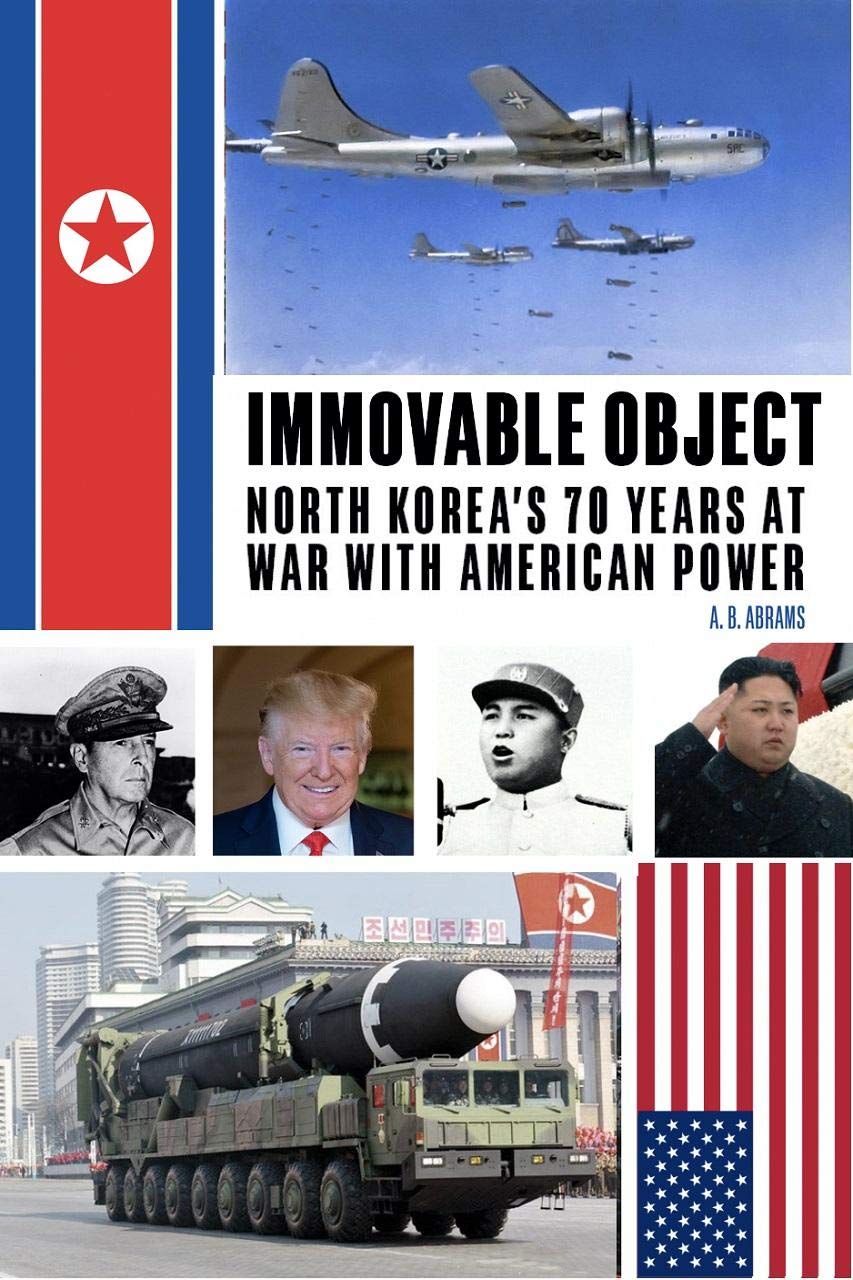


 What's Left